
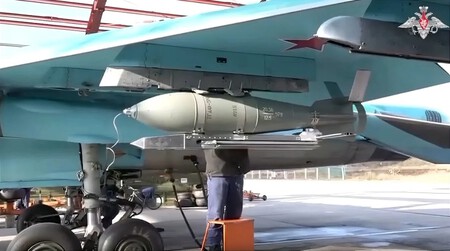
The Initial Shock of Russia’s Gliding Bombs
Two years ago, Russia unleashed a FAB-3000 pump, a three-ton explosive over Kharkov, causing a shockwave powerful enough that local seismic sensors registered it like a minor earthquake. This marked a turning point for Ukraine, which had limited means to counteract a weapon capable of striking from tens of kilometers away.
The Nightmare That Changed the War
In 2023 and 2024, Russian gliding bombs emerged as one of the war’s most devastating weapons. By transforming old Soviet bombs into long-range munitions with affordable wings and guidance systems, Moscow created a formula for mass destruction. These large FABs, weighing 250, 500, or even 1,000 kilos, could be launched from considerable distances, evading many Ukrainian anti-aircraft defenses and devastating fortified positions, bridges, and logistics centers.
This newfound capability posed a nearly impossible challenge for Ukraine. Not only was shooting down each bomb difficult, but attacking the launching aircraft often forced them closer to the front lines. The siege on Ukrainian cities like Kharkiv and Sumy intensified pressure, complicating defense strategies.
Ukraine’s Response Over Seventeen Months
Fast forward to now: the introduction of Ukraine’s first gliding bomb, the Vyrivniuvach (“Equalizer”), symbolizes a significant shift in the battlefield dynamics. Development began in December 2024, involving 17 months of assessments and tests. This weapon features a 250-kilogram warhead, crafted specifically for the unique challenges of modern warfare in Ukraine.
Built by Ukrainian engineers to adapt to low-altitude flying for radar evasion and affordable manufacturing, the Vyrivniuvach represents both military and strategic advancements in Ukraine’s defense capabilities.
The Importance of Domestic Production
Historically, Ukraine relied on Western kits like the JDAM-ER for converting conventional bombs into guided ones. However, the dependency on these external systems created vulnerabilities, as they arrived in limited quantities and were subject to political constraints.
Recognizing the need to grow its own war industry, Ukraine’s Vyrivniuvach is designed to be cost-effective—approximately three times cheaper than a JDAM-ER—and can be quickly integrated into existing operational aircraft such as the Su-24, MiG-29, Su-27, and even Western F-16s.
A Turning Point in Warfare Dynamics
The evolution of gliding bombs reflects a seismic shift in modern warfare principles. While cruise missiles once signified precision strikes, both Ukraine and Russia have demonstrated that adaptations of older weapons can yield more practical and effective military solutions, allowing for greater production in times of conflict.
As Russia utilized converted FABs with UMPK modules as a method of constant attrition against Ukrainian defenses, Ukraine is now adopting similar tactics. The Vyrivniuvach allows strikes from beyond the reach of Russian air defenses, forcing adversaries to use costly anti-aircraft interceptors or face destruction.
New Tactical Paradigms
The Vyrivniuvach is crafted to hit targets “tens of kilometers” behind enemy lines, minimizing risks to pilots by allowing attacks without directly entering areas heavily protected by air defenses. As a domestically produced system, it enables Ukraine to target any location deemed necessary without awaiting external approval.
Ukraine’s Industrial War Effort
The introduction of the Vyrivniuvach showcases Ukraine’s transformation from a nation reliant on foreign military assistance to one capable of rapid military innovation. Within two years, Ukraine has successfully developed long-range kamikaze drones, unmanned naval systems, and potent electronic warfare solutions, rapidly adapting to the requirements of a protracted conflict.
In summary, while Russia’s gliding bombs initially highlighted Ukrainian vulnerabilities, the emergence of the Vyrivniuvach marks a profound shift. Ukraine has shown its capability to turn the tide by adopting similar technological innovations, demonstrating resilience and ingenuity in the face of adversity.