
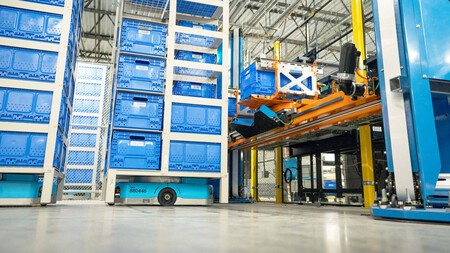
In some of Amazon’s most advanced logistics centers, robots are no longer an aid: they are a majority . They move tirelessly, raise shelves, scan packages, and feed a huge distribution network . Automation is ceasing to be a promise and evolving into a reality that could transform the entire industry.
Amazon has already deployed more than one million robots in its logistics centers. The company itself claims it has been automating numerous tasks previously performed by people. This figure not only marks the highest recorded so far but also reflects the critical role that automation has begun to play in the system.
As reported by Red Stag Fulfillment, Amazon had approximately 1.56 million employees globally by 2025, with about 1.1 million of them in the United States. When comparing both figures, the number of robots approaches that of human workers, demonstrating the rapid evolution of robotics in the workplace.
It All Started More Than a Decade Ago
In 2012, Amazon made headlines by paying $775 million for Kiva Systems, a firm specializing in mobile robots that move shelves in warehouses. This unexpected acquisition was not just about technology; it was a declaration of principles . Amazon was taking control of its future in automation.
Following the acquisition, Amazon began to integrate Kiva technology into its logistics centers. What started as a specialized startup in material management became the heart of a silent transformation that redefined how millions of daily orders are processed.
Initially, Kiva robots were limited to transporting shelves filled with products without packaging them. This practical solution aimed to eliminate physically taxing and repetitive tasks. Over time, however, robotics roles expanded dramatically. Today, robots not only move items but also package, classify, lift weights, organize loads, and even optimize routes within the warehouse continuously.
In several centers, more than 70 robotic arms classify millions of items, fill paper bags, close cast cars, and collaborate directly with human staff . “The acquisition of Kiva marked the beginning of our robotic journey,” Amazon explains. “But it was just the beginning.” What followed showed the necessity of this innovation.
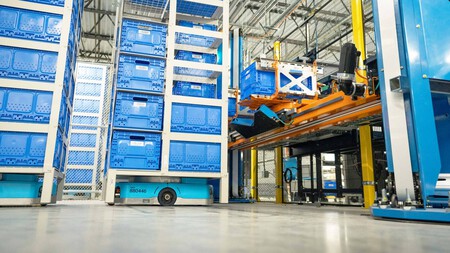
Amazon has not only multiplied the number of robots in its warehouses but has also diversified its catalog to create an ecosystem of specialized machines, each with specific functions and increasing degrees of autonomy.
Among the most advanced systems is Sequoia, a platform that employs artificial intelligence to manage inventory much faster. It enables identifying and storing products 75% faster than traditional systems by moving items directly to designated storage areas or to operators positioned to avoid injuries, typically between chest and thigh height.
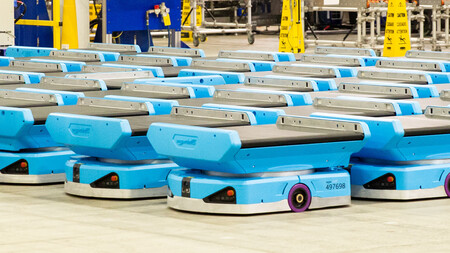
Alongside it, other mobile units like Hercules and Titan are responsible for moving complete shelves—known as pods—to workstations. Titan is more robust and can transport larger and heavier items, such as small appliances or pallets. Both models autonomously navigate marked floors with codes, avoid obstacles, and adjust their movements in real time.
For more specialized tasks, we have Vulcan, the first Amazon robot with a sense of touch . It can gauge how much force is needed to grasp an object and detect when it has made contact, enabling it to handle fragile or awkwardly placed items without causing damage. It is particularly effective at the upper and lower levels of warehouses.
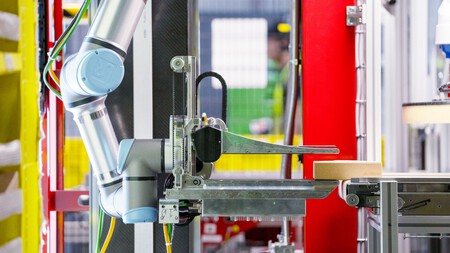
The process continues with Sparrow, a robotic arm capable of identifying, grabbing, and placing products into the correct containers using computer vision and machine learning. Following that, packaging systems create customized paper bags for each order using sensors and thermal seals.
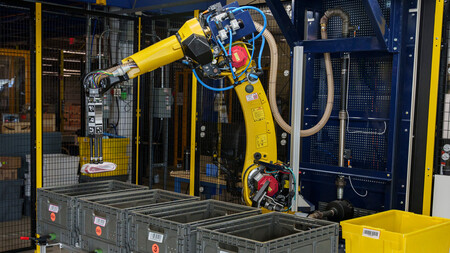
Furthermore, Robin and Cardinal are robotic arms that collect packages, detect damage, and place them in cars, even when weighing up to 23 kilos . Ultimately, Proteus, Amazon’s first autonomous robot, roams the warehouse freely, transporting these cars to the exit zone without human assistance.
Among this extensive array of machines, humanoid robots generate significant interest. What functions do they serve? Are they integrating into logistics centers? The response is nuanced. While Amazon has begun experimenting with humanoid robots, their presence remains limited and their roles quite specific.
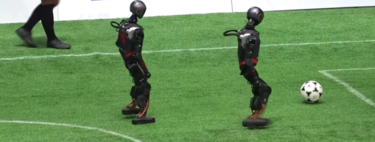
In 2023, Amazon announced the initiation of tests with Digit, a bipedal robot developed by Agility Robotics, a company in which Amazon has invested through its industrial Innovation Fund. Measuring 1.75 meters , Digit can carry loads of up to 16 kilos . Its inaugural task is aimed at aiding in the recycling of totes—the empty boxes continuously transported after content processing.
Images | Amazon (1, 2, 3, 4, 5)