
Roberto Sánchez’s Call for Collaboration to Combat Poverty and Corruption
A Willingness to Engage
Roberto Sánchez, the presidential candidate from Together for Peru, has made headlines with his recent statement expressing a willingness to engage in dialogue with his political rival, Keiko Fujimori of Fuerza Popular. This gesture comes at a crucial time as the official scrutiny of ballots from the runoff election shows Sánchez in a favorable position, leading by more than 33,000 votes.
Emphasizing Unity Against Common Adversaries
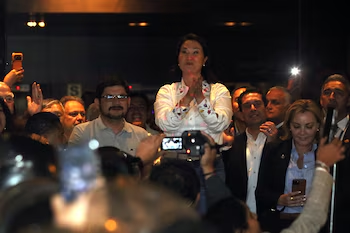
Speaking to the media outside a restaurant in Lima, Sánchez emphasized the importance of uniting all political sectors to tackle pressing national issues. He articulated a clear vision: “In order to defeat poverty, exclusion, and corruption in our homeland, we must be able to meet with all Peruvians.” This remark underscores his commitment to inclusiveness, regardless of political alignment.
A Transparent Election Process
Sánchez has insisted that the electoral process must conclude “fully and transparently,” highlighting his desire for credibility in the democratic process. He declared that what matters most is “seriousness” and “tranquility” as the electoral results are finalized. According to recent data from the National Office of Electoral Processes (ONPE), Sánchez currently holds 50.094% of the votes, with a total count of approximately 8,858,465 votes.
A Gesture Toward Keiko Fujimori
When asked whether this call for broader dialogue includes a potential meeting with Fujimori, Sánchez indicated openness, marking a significant first step toward reconciliation. This willingness to reach across the aisle could be pivotal in fostering a spirit of collaboration that many believe is essential for the country’s progress.
A Shared Commitment
In his statements, Sánchez reiterated that the “only visible enemy” facing Peruvians today is corruption and poverty. By gathering the support of all political players, he hopes to enhance efforts to eradicate these issues, which have plagued the country for years. He believes that unity is necessary to provoke the “broadest consensus” to address these challenges.
Current Election Landscape
As the election outcomes continue to be scrutinized—around 94.827% of ballots counted—Fujimori trails closely behind, capturing 49.906% of the votes, translating to approximately 8,825,073. The narrowing margin of 33,392 votes indicates the contentious nature of this election and adds significance to Sánchez’s call for unity.
Conclusion: A Path Forward
Roberto Sánchez’s invitation to dialogue reflects a promising direction for Peruvian politics. By seeking cooperation with rivals like Keiko Fujimori, he is paving the way for a more unified approach to governance. As both candidates continue to navigate the election landscape, the hope for collaboration may emerge as a vital theme in the months to come, driven by a shared commitment to combatting poverty and corruption in Peru.