
Roberto Sánchez: A Closer Look at the Electoral Landscape
The recent presidential runoff in Peru has sparked significant discussion concerning the electoral performance of Roberto Sánchez, particularly in comparison to Pedro Castillo, the former president. An analysis reveals a striking disparity: Sánchez garnered nearly 87,000 fewer votes than Castillo in nine regions across the nation, a loss that proved pivotal in the election outcome.
The Electoral Impact of Overseas Votes
In the aftermath of the 2026 presidential runoff, much attention has been focused on the overseas vote, where Keiko Fujimori secured a decisive advantage. This external factor was seen as instrumental in flipping the national result. The vote difference between Sánchez and Fujimori was a mere 49,641, which is one of the narrowest margins in Peru’s recent electoral history.
Yet, a comprehensive review by Infobae Peru indicates that Sánchez’s underperformance may also be attributed to domestic factors. Compared to the supports garnered by Pedro Castillo during the 2021 election, Sánchez failed to maintain the same level of backing in key regions, particularly those that had previously favored the left-wing agenda.
Regional Disparities in Voting
The statistics are telling: in nine regions, Sánchez faced a shortfall of 86,686 votes compared to Castillo’s performance in 2021. This difference greatly overshadows the slim margin distinguishing Javier Fujimori’s victory. The lack of support in these regions emerged as a crucial determinant for the presidential race’s outcome.
Breakdown of Vote Losses
- Fist: Sánchez recorded a deficit of 32,532 votes.
- Cajamarca: Here, Sánchez fell short by 15,693 votes.
- Cusco: A reduction of 13,900 votes was noted.
Overall, the three regions of Puno, Cajamarca, and Cusco accounted for 72% of the total vote loss, underscoring their significance in the election. Had Sánchez matched Castillo’s previous numbers in these areas, the final results could have vastly differed, potentially altering Fujimori’s victory margin.
The Challenge of Inherited Political Legacy
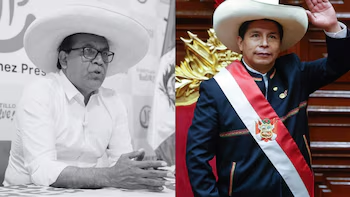
Roberto Sánchez attempted to carve a political identity as the successor to Pedro Castillo, even donning the traditional hat symbolizing Castillo’s campaign. However, the strategy failed to resonate sufficiently among the electorate, as evidenced by the lack of enthusiastic support in historically significant regions.
The Broader Implications
Despite Sánchez’s efforts, the accumulated loss of 86,686 votes starkly illustrates that factors beyond overseas voting influenced the national result. The decline in votes in regions that had once been staunch strongholds for the left suggests a fracture in the electorate’s support structure for leftist candidates in Peru.
In summary, the results from the 2026 presidential runoff not only highlight the critical role of local political dynamics but also the importance of cohesion within the voter base for left-leaning candidates. As analysts sift through the implications of these numbers, the need for understanding and addressing the reasons behind the voting shifts becomes ever more vital for future electoral strategies in Peru.