
Current Challenges in the Spanish Rice Sector
Spanish rice farmers are navigating treacherous times, primarily due to external competition rather than internal crop issues. Although recent seasons have shown improvements in harvested areas and positive estimates for the upcoming 2025/2026 campaign, concerns remain about plummeting prices and escalating imports.
Weather and Drought Conditions
Historical Context
The last few years have been particularly harsh for rice cultivators in Spain. Persistent droughts have significantly reduced both the cultivated area and overall production. According to the Esyrce survey by Spain’s Ministry of Agriculture (MAPA), the average area dedicated to rice farming has never dipped below 100,000 hectares in this century. However, severe water shortages have altered this trajectory.
Recent Developments
This season marks a slight turning around of fortunes. In June, MAPA estimated a rise in cultivated land to 97,000 hectares, reflecting an increase of 12.9% from the previous year. The projected national rice harvest for 2025/26 stands at approximately 761,515 tons, representing a bulk increase of 27.43% from the previous campaign. Yet, these figures, while promising, remain distant from the sector’s peak production of over 900,000 tons in 2011.
Cautious Optimism
Despite these encouraging indicators, a sense of caution pervades the rice industry. In a recent statement, Cooperativas Agro-Alimentarias acknowledged the uncertainty facing national crops. The situation remains “extremely extreme,” characterized by prices often failing to cover production costs.
Farmers’ Concerns
Farmers are especially alarmed by recent environmental impacts, such as the effects of DANA 2024 in La Albufera, hail damage in the Ebro Delta, and the influence of summer heat waves and rains. They also note a troubling scarcity of agronomic tools due to phytosanitary restrictions, complicating pest management strategies.
Price Pressures & Import Competition
Falling Prices
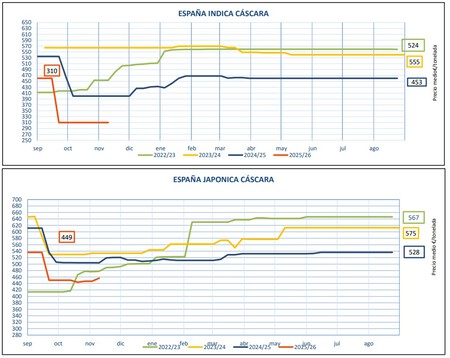
With prices of the indica variety falling sharply—from 555 euros per ton in 2023 to just 310 euros this year—many Spanish farmers fear they won’t be able to sell up to 20% of their long rice due to strong competition from cheap imports.
Import Dynamics
The issue is compounded by rice imports from countries like Cambodia and Myanmar, which benefit from the EU’s Everything But Arms (EBA) initiative that offers tariff-free access to European markets since 2009. Despite some regulatory changes, Spanish farmers argue that these imports are pushing prices down, making it nearly impossible for them to compete.
EU Dependency and Future Outlook
The EU acknowledges its dependence on rice imports, especially of the indica variety, with significant quantities coming from Cambodia, India, and Thailand. Current agreements allow the entry of around 635,690 tons of milled rice annually without tariffs. Industry experts warn that without immediate corrective measures, the future of the Spanish rice sector could be jeopardized.
Call for Action
Leading figures in the industry, such as Ignacio Huertas from UPA, demand reciprocity in trade agreements and automatic safeguard clauses to protect local farmers. The ongoing negotiations regarding the Generalized Scheme of Preferences (GSP) will be crucial in determining the future landscape for rice farming in Spain.
Images courtesy of: