
The Evolving Landscape of Democracy in the 21st Century
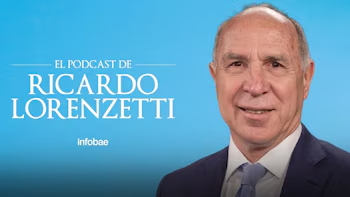
In Episode 22 of Ricardo Lorenzetti’s podcast, the magistrate presents an invigorating perspective on how democracy is navigating a world rife with simultaneous crises. Issues such as artificial intelligence, climate change, political polarization, and social fragmentation are often treated as disconnected phenomena. However, Lorenzetti posits that these challenges are intertwined, marking the end of a historical cycle and calling for a re-evaluation of democratic coexistence.
Decentralized Democracy: A New Paradigm
Opening the discussion, Lorenzetti emphasizes that “the democracy of the 20th century was concentrated in the representatives, while the democracy of the 21st century is decentralized.” This shift towards decentralization signifies not a dissolution of democracy, but rather an expansion of its scope. Political discourse is evolving beyond the traditional frameworks to incorporate more active Congresses, influential judicial powers, and engaged citizenries that directly shape public agendas.
The Rise of Congress as a Power Player
One of the episode’s pivotal themes is the newfound prominence of Congress, even in presidential systems. Lorenzetti highlights various recent instances where parliaments have effectively limited executive authority and redefined vital decisions. Congress is no longer a passive entity; it has emerged as a significant arena for political contention, capable of directly influencing governance.
The Judicial System in the Spotlight
Additionally, the role of judicial powers has evolved. No longer are courts merely institutions that enforce laws; they have actively engaged in protecting fundamental, social, and environmental rights. Such involvement has reshaped economic and political landscapes, altering the traditional checks and balances within state powers. According to Lorenzetti, this transformation is not an aberration but a natural progression of increasingly complex democracies that respond to more demanding societal needs.
Reimagining Citizenship in Modern Democracy
The concept of citizenship has also transformed significantly. Feminist, environmental, labor, and social movements have successfully brought pressing issues to public discourse, often garnering legitimacy that surpasses that of elected officials. As Lorenzetti asserts, modern democracy no longer functions solely from a top-down approach; it now facilitates a horizontal exchange of demands, narratives, and identities.
Beyond Procedural Democracy
Confronting this complex landscape, Lorenzetti calls for a departure from a purely procedural understanding of democracy. For much of the 20th century, democratic theory fixated on procedural rules—how representatives are chosen and decisions are made. Influenced by thinkers like Hayek and Buchanan, this procedural focus inadvertently ceded too much authority to the market, exacerbating inequalities. Lorenzetti advocates for a reflective democracy that can navigate conflicts rather than shun them.
Re-envisioning Political Leadership
This evolving democratic framework necessitates a redefinition of political leadership. Today’s leaders must transcend partisanship and use conflict as a resource for progress. Their responsibility is to facilitate debate, establish reflective institutional environments, and gradually dissolve extreme positions, transforming conflict from a hindrance into a valuable democratic input.
Integrating Justice and Collective Goods
Another essential aspect addressed is the critical need to repoliticize democracy through a substantive conception of justice. Drawing on the thoughts of John Rawls and Ronald Dworkin, Lorenzetti emphasizes that individual rights must be interconnected with collective goods to avoid societal chaos. Economic freedom and innovation should coexist with environmental sustainability and social equity.
The Veil of Ignorance: A Democratic Tool
To foster fairer public policy discussions, the episode presents the “veil of ignorance” concept. Imagining society’s rules without knowing one’s societal position encourages a less partisan dialogue, paving the way for more equitable democratic processes.
The Role of Identity in Democracy
Lastly, Lorenzetti delves into the often-overlooked yet crucial dimension of identity within democracy. In an increasingly globalized world where identities can fragment, cohesive national identity becomes vital for maintaining governance and preventing authoritarianism. This underscores the importance of constitutional values as a foundation for shared identity and a renewed social contract.
The Challenge Ahead
As Lorenzetti concludes, updating democracy does not mean dismissing its essence; it calls for an expansive, reflective, and equitable democratic system capable of addressing conflicts, rights, and diverse identities. This represents a core challenge for sustaining democratic governance in the 21st century.
Don’t miss out on new episodes of Ricardo Lorenzetti’s podcast every Monday at 9 AM on Infobae and Spotify!