
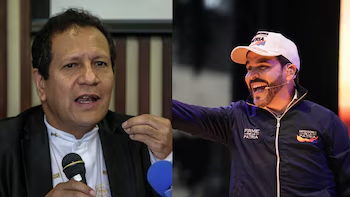
Reasons Behind the Call to Overthrow Abelardo de la Espriella’s Presidency
The political landscape in Colombia is currently in turmoil amid controversy surrounding the presidency of Abelardo de la Espriella. A legal challenge led by former magistrate Luis Guillermo Pérez seeks to halt the inauguration scheduled for August 7, citing multiple severe allegations that bring the legitimacy of the electoral process into question.
Allegations of Dual Nationality
One of the cornerstone arguments of Pérez’s lawsuit is centered on De la Espriella’s alleged dual citizenship. As reported, he is said to hold U.S. citizenship, which, according to Pérez’s interpretation of the constitution, disqualifies him from serving as President of Colombia. “It is incompatible for a U.S. citizen to seek to serve as head of state in Colombia,” Pérez asserted, reflecting deep-rooted concerns about national loyalty and governance.
Potential Foreign Interference
The second allegation involves claims of foreign intervention in De la Espriella’s campaign. Pérez referenced comments from former U.S. President Donald Trump, who purportedly hinted at having supported De la Espriella’s electoral victory. This connection raises alarms regarding the independence of Colombian elections and posits a risk of external influence.
Additionally, De la Espriella’s acknowledged ties to the Republican Party draw further scrutiny. Pérez suggests that such affiliations warrant examination by the high court to ensure that domestic interests remain safeguarded from foreign entanglement.
Stigmatizing Speech and Political Violence
Another troubling point in the lawsuit pertains to the ‘stigmatizing speech’ employed during De la Espriella’s campaign. Allegations surfaced regarding intimidating rhetoric, with Pérez previously filing criminal complaints against the president-elect for statements that included references interpreted as threats and encouragement of political violence. Phrases such as “the tiger and his pack” have been characterized as part of a broader pattern of campaign language designed to instill fear rather than motivate voter engagement.
Irregularities in Vote Counting
The lawsuit rounds out its four key allegations with claims of vote counting irregularities. Pérez has highlighted over 100 tables under review for inconsistencies, specifically focusing on votes counted outside of Colombia. Concerns have also been raised regarding access to crucial electoral documents, shedding light on potential discrepancies that cast a shadow over the electoral process’s integrity.
Implications for Democracy
With the lawsuit in play, Pérez calls for the presidential inauguration to be postponed until the Council of State resolves these pressing legal issues. This case has reignited a national debate about electoral transparency, citizen rights, and the necessary safeguards against potential abuses in the election process.
As the country waits for the Council of State’s judgment, the outcome could uphold or significantly alter the political trajectory of Colombia, emphasizing the vital importance of a transparent electoral system. Civil discourse around this case indicates a population deeply invested in the integrity of their democratic system, seeking accountability from those in power.
The unfolding debate highlights broader implications for Colombia’s democratic fabric, reinforcing the need for vigilance in electoral integrity and political accountability.