
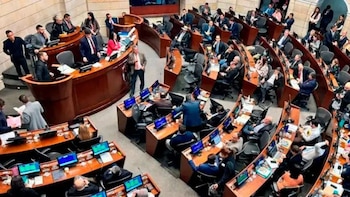
The Radical Change Party announced the presentation of a criminal complaint for prevaricate and a disciplinary complaint against the magistrates of the National Electoral Council (CNE), Fabiola Márquez and Alba Lucía Velásquez . This action stems from their controversial decision to suspend the sanctions imposed on the senators Ana María Castañeda and Temístocles Ortega , thereby allowing them to participate in the critical vote to choose the new magistrate of the Constitutional Court .
On September 3, 2025 , the community formalized the complaint before the Supreme Court of Justice and filed a disciplinary complaint with the Attorney General’s Office in Bogotá . According to the Radical Change Party, the magistrates in question incurred prevaricate by issuing precautionary measures that, as claimed, contravene existing regulations and unfairly favor the sanctioned lawmakers.
Now you can follow us in our WhatsApp Channel and in Facebook
The heart of the issue lies in the sanctions that the Ethical Control Council of Radical Change imposed on Senators Castañeda and Ortega, which deprived them of a voice and vote within the party. Following notification of the sanction to Senator Castañeda on August 28 , both legislators filed challenges with the CNE aiming to reverse the sanctions and regain their political rights.
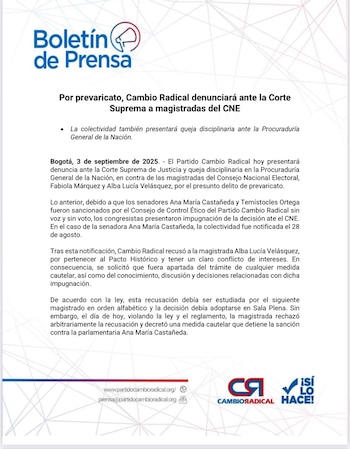
In response to these challenges, Radical Change initiated actions against the involved magistrates. The challenge against Alba Lucía Velásquez was predicated on her affiliation with the Historical Pact Movement , which the party viewed as a significant conflict of interest .
As a result, the party requested Velásquez’s removal from any involvement in proceedings concerning precautionary measures, alongside the discussion and decision on Castañeda’s challenge. According to party claims, the law dictates that such challenges be evaluated by the next available magistrate in alphabetical order, with resolutions made collectively in the Plenary Sala of the CNE . However, Radical Change asserts that Judge Velásquez dismissed the challenge and subsequently issued a precautionary measure that lifted the sanctions against Senator Castañeda, allowing her to vote in the upcoming magistrate elections.
Regarding Temístocles Ortega , the party claims it was not properly notified of the challenge initiated by the senator before the CNE. Instead, they learned of this issue through a communication issued by the Secretary of the Senate . Following this incident, Radical Change similarly challenged Judge Fabiola Márquez for reasons akin to those cited in Velásquez’s case, citing a possible conflict of interest.
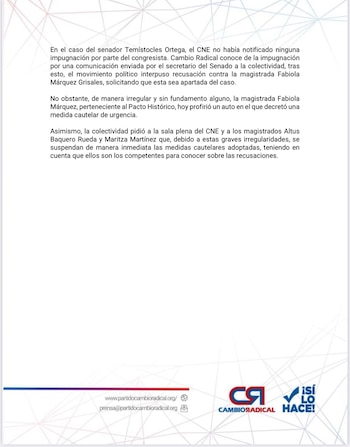
Regardless of these challenges, Márquez, also part of the Historical Pact, issued an order affirming an emergency precautionary measure, a move Radical Change has branded as irregular and devoid of any legal foundation . The party contends that both magistrates acted contrary to established procedures by dismissing the challenges while adopting precautionary measures that lifted the sanctions imposed on the senators.
Radical Change has formally requested that the PLENA DEL CNE room and magistrates Altus Baquero Rueda and Maritza Martínez , duly competent to address the challenges, take immediate action to annul the questioned precautionary measures.
In a related context, the Movement Indigenous Authorities of Colombia (AICO) provisionally suspended the voice, vote, and political representation of Senator Richard Humberto Fuelantala , blocking him from participating in the election of the new magistrate of the Constitutional Court, as outlined in Resolution No. 025 from September 2, 2025 .
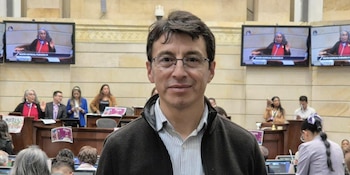
This sanction, rooted in article 20, literal H of AICO’s internal statutory regime and various articles from the Political Constitution of Colombia , stems from evaluating the senator’s legislative actions in accordance with the official document. The party underscores that the Constitution guarantees both the right to choose and the effective exercise of political representation, principles enshrined in multiple articles of the Magna Carta .
The measure has temporarily stripped the sanctioned senator of their spokesperson role and participation in party decisions, consequently excluding them from the pivotal vote on electing the new magistrate for Colombia’s Constitutional Court , a decision critical to the legislative agenda. The Senate of the Republic of Colombia is set to name the new magistrate in a plenary session this Wednesday, a highly anticipated decision that could shape the influence of the court on the national legal system.