
In a special event held today, Qualcomm has announced the acquisition of Arduino. Although the financial terms of the agreement have not been revealed, those responsible for both companies have made it clear that Arduino will continue to operate independently.
We are witnessing a unique Qualcomm commitment to the Open Source philosophy that has always been at the heart of Arduino, both in the development of its hardware solutions and the software that powers them. It’s important to note that this agreement is not the only strategic move Qualcomm has made in recent years to strengthen its position in the technology arena.
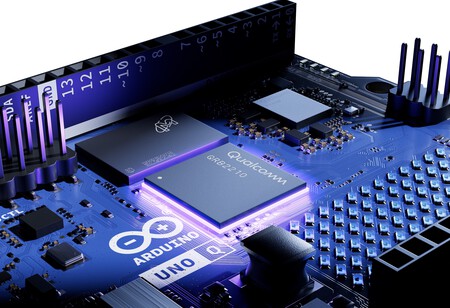
While this agreement makes it a logical option for Qualcomm to offer some of its chips in the future catalog of Arduino solutions, representatives of the company have clarified in an online meeting with journalists that this will not change their approach to designing hardware solutions. They will continue to source chips from various manufacturers in order to select the best components for their objectives.
For Arduino, this partnership signifies an absolute vote of confidence in their project and philosophy. Qualcomm’s involvement provides diversification and a gateway to a community of developers and electronics enthusiasts that can further help broaden Arduino’s reach into the industrial electronics market.
Arduino, more and more “pro”
This agreement also reinforces a professional and industrial orientation of Arduino’s solutions, a transition that has been evolving over the past few years. From a business perspective, this shift seems both logical and inevitable.
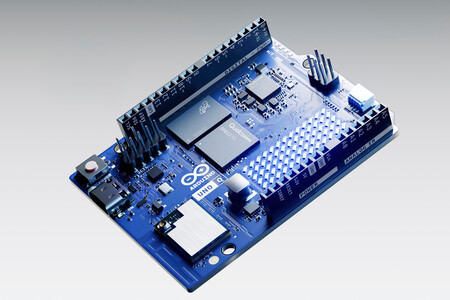
Arduino started as an academic project aimed at electronics enthusiasts and quickly became a beacon of the Maker movement. Utilizing 8-bit microcontrollers that were easy to use and affordable, it allowed a vast community of developers to adopt its open approach and promote the development of Open Source electronics.
Gradually, the project grew and began its transition to industrial applications. This involved moving from rapid prototyping to more complex 32-bit boards with greater processing and memory capabilities, enabling a broader spectrum of ambitious uses.
Since 2016, Arduino has launched various models aimed at IoT and connectivity, strengthening its focus on industrial applicability. Notably, the company introduced the Arduino Porta family, a line aimed specifically at industrial automation solutions.
Notably, these advancements did not overshadow Arduino’s original spirit; solutions for electronics enthusiasts remain vibrant and evolving. In fact, the acquisition has already yielded new products from Arduino.
Arduino One Q: a full-fledged mini-PC
The announcement of the acquisition coincided with the launch of an innovative product named Arduino One Q. This exciting new board represents a significant advancement within the Arduino family.
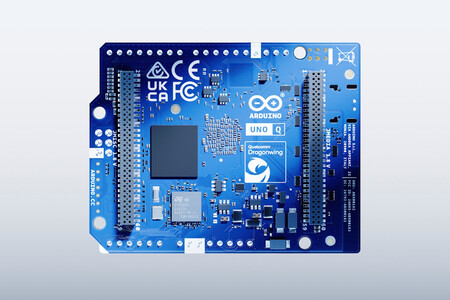
What makes this board stand out is its impressive hardware combination. It features the STM32U585 microcontroller alongside Qualcomm’s Dragonwing QRV2210 microprocessor. This powerful microprocessor includes a Quad-Core CPU with Cortex-A53 cores clocked at up to 2.0 GHz, 2-4 GB of RAM, and a robust 512 kB of L2 cache, along with an Adreno 702 graphics unit for media processing.
This board can be used to develop and run AI applications, enabling capabilities such as image and face recognition when connected to a camera.
To facilitate custom solution development, it comes with an application development environment designed specifically for ease of use with this board.

Essentially, this mini-PC can function autonomously. Although it can connect to a laptop or desktop for programming, it can also operate independently when connected to a monitor, keyboard, and mouse, allowing direct interaction with its Debian operating system and the Lab app for development.
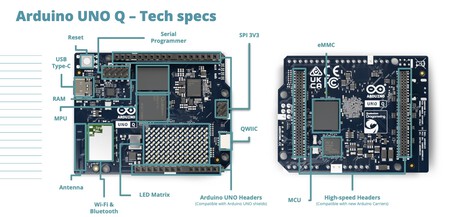
This new product marks a significant leap in both functionality and maintains the core principles of the original Arduino ethos. Both hardware — including schematics and designs — and software, such as the Lab app and CLI, continue to be released under Open Source licenses.
While Qualcomm may have acquired Arduino, the essence of this groundbreaking project that has democratized the world of electronics alongside others like Raspberry Pi appears to remain firmly intact.