

What were the key factors contributing to the major drop in the crypto market during Q1 2025? How did Bitcoin’s dominance change in response to the market downturn? What impact did the decline in investor activity have on daily trading volumes? Which altcoins were most affected by the market trends, and how did their performances compare to Bitcoin?
The crypto market suffered a major drop in the first quarter of 2025 from the record-breaking highs of late 2024. While altcoins saw a significant hit, Bitcoin strengthened its dominance, according to the latest crypto industry report by crypto data aggregator CoinGecko.
The report found that in Q1, the total crypto market capitalization lost $633.5 billion, or 18.6%, to $2.8 trillion. The local top was $3.8 trillion on 18 January, two days before US President Donald Trump’s inauguration. From then on, it trended downwards.
Notably, “the decline was accompanied by a drop in investor activity,” the CoinGecko researchers noted. The average daily trading volume decreased by 27.3% quarter-on-quarter to $146 billion. In comparison, the trading volume in the fourth quarter of 2024 was $200.7 billion.
Meanwhile, Bitcoin’s dominance continued to rise. It went up by 4.6 percentage points, ending Q1 with a 59.1% dominance amidst the general downturn. This level was last seen in Q1 2021.
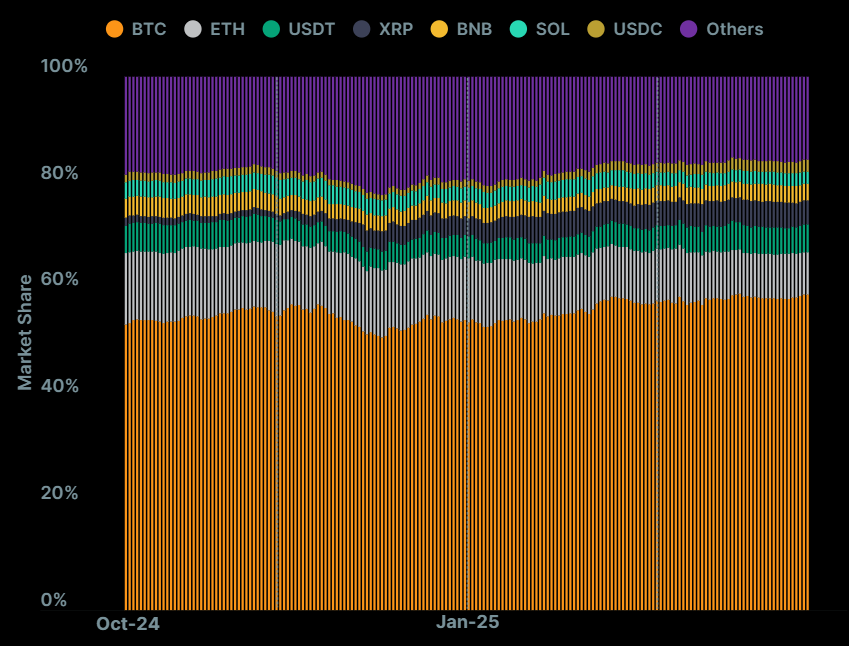
Furthermore, stablecoins “benefited from the market downturn,” as well. This is because investors turned to this asset type seeking stability.
However, Ethereum dropped by 3.9 percentage points, with its dominance at 7.9%. This is the lowest it has been since late 2019, the report noted.
Only XRP and BNB among the ‘major’ coins preserved their market share.
Market Sees Plunging Prices, Trading Volumes, TVLs
In January 2025, BTC reached its new all-time high of $106,182. However, by the end of Q1, it fell 11.8% to $82,514.
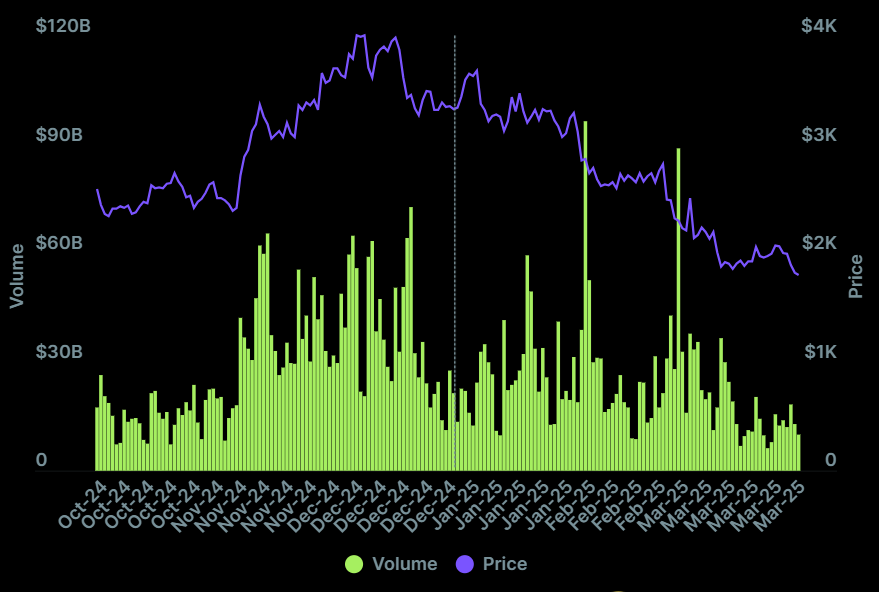
At the same time, ETH ended the quarter with a whopping 45.3% decrease to $1,805. “It has erased its gains from 2024, returning to levels last seen in 2023,” the report said. The coin “severely underperformed majors such as BTC, SOL, XRP, and BNB, all of which declined to a much lesser degree.”
Furthermore, trading volume fell from a daily average of $30 billion in Q4 2024 to $24.4 billion in Q1 2025. The report noted that the days in which volume spiked saw the price of ETH plummet.
Meanwhile, multichain DeFi Total Value Locked (TVL) dropped 27.5% from $177.4 billion at the end of 2024 to $128.6 billion at the end of March 2025. “This was largely due to the significant depreciation in value of altcoins,” CoinGecko said.
Among the chains, Ethereum lost “a significant portion” of its TVL: 35.4% from $112.6 billion to $72.7 billion.
Furthermore, Solana and Base recorded notable decreases of 23.5% and 15.3%, respectively.
CEX and DEX
The report found that in the first quarter of this year, the top 10 centralized exchanges (CEXs) recorded $5.4 trillion in spot trading volume. This is a 16.3% decrease quarter-on-quarter.
Binance was still the dominant spot CEX, with a 40.7% share at the end of the quarter. While its market share increased over the quarter, its trading volume fell to $588.7 billion in March. In comparison, it surpassed the $1 trillion mark in December.
However, in the top 10, HTX was the only exchange to grow in Q1 (11.4%), while the rest dropped between 1.8% and 34%. The latter was Upbit’s decrease, falling to $371 billion.
Month-on-month, unsurprisingly, Bybit fell the most: 52.4% from $178.2 billion to $84.7 billion.
Meanwhile, when it comes to decentralized exchange (DEX) trading, Solana dominated the space. It saw a 35.3% rise from $217 billion in Q4 to $293.7 billion in Q1, with a market share of 39.6% in the first quarter.
Notably, in January, Solana accounted for 52% of on-chain trades amongst the top 12 blockchains. This was “driven by the ‘political memecoin’ frenzy” led by the TRUMP coin.
Solana recorded an all-time high of over $184.8 billion in trading volume, reducing Ethereum’s market share to below 20% for the first time.
That said, Ethereum reclaimed the top spot in March, the report said, with a 30.1% market share compared to Solana’s 23.4%.
Finally, Optimism and Polygon fell out of the top 10 in March as newcomers Sonic and Berachain moved in. “However, over the entire quarter, both chains stayed ahead,” the report concluded.
The post Q1 2025: Bitcoin Boosts Dominance as Market Cap and Investor Activity Plunge appeared first on Cryptonews.
Q1 2025: Bitcoin Boosts Dominance as Market Cap and Investor Activity Plunge
As the cryptocurrency landscape evolves, the first quarter of 2025 has unveiled a fascinating yet tumultuous chapter in the saga of digital assets. Bitcoin, the pioneer and perennial heavyweight of the crypto world, has experienced a resurgence in its market dominance, even as the overall market capitalization and investor activity have seen significant declines. This paradox highlights the intricate dynamics at play within the cryptocurrency ecosystem, reflecting both consolidations of power and shifts in investor sentiment.
The State of the Crypto Market in Q1 2025
To fully understand Bitcoin’s dominance in Q1 2025, it’s crucial to examine the broader context of the cryptocurrency market during this period. At the onset of 2025, the total market capitalization of all cryptocurrencies saw a dramatic fall, dropping below $600 billion—a stark contrast from previous highs nearing $1.5 trillion. This decline has been attributed to various factors, including regulatory concerns, market corrections, and macroeconomic uncertainties affecting risk assets globally.
Investor activity also took a hit, with trading volumes tapering off significantly compared to previous quarters. Retail investors, once buoyed by fervent enthusiasm for new and emerging cryptocurrencies, have largely retreated, seeking safer havens for their capital amidst a landscape characterized by volatility and uncertainty.
Bitcoin’s Resurgence
In this challenging environment, Bitcoin has managed to boost its market dominance. By the end of Q1 2025, Bitcoin’s market share reached approximately 53%, an increase from 40% just six months prior. Several factors contribute to Bitcoin’s renewed position as the market leader.
1. Safe Haven Appeal
In turbulent times, investors often gravitate toward perceived safe havens. For many, Bitcoin represents a digital equivalent to gold, a hedge against inflation and an asset that is less susceptible to the fluctuations experienced by altcoins. As other cryptocurrencies have faltered, Bitcoin has reaffirmed its stature, attracting those seeking stability.
2. Institutional Adoption
Institutional interest in Bitcoin appears to be a stabilizing force. Major financial institutions have continued to explore and integrate Bitcoin into their portfolios, signaling confidence in its long-term viability. This adoption includes custodial services, Bitcoin exchange-traded funds (ETFs), and even direct purchases by asset management firms. The entry of institutions has lent a degree of legitimacy to Bitcoin, further separating it from the altcoin crowd.
3. Technological Advancements
Bitcoin’s ongoing evolution has also bolstered its position. Upgrades to its network, including enhancements that improve scalability and transaction efficiency, have made it a more attractive option for both investors and users. Additionally, the Bitcoin Lightning Network, aimed at facilitating faster transactions for smaller amounts, addresses one of Bitcoin’s longstanding criticisms regarding transaction speed.
Investor Sentiment and Market Dynamics
Despite Bitcoin’s strength, the overall investor sentiment in Q1 2025 remains cautious, dictated by external economic conditions. Inflation concerns, geopolitical tensions, and a rising interest rate environment have influenced a risk-off attitude among traders. As a result, many smaller altcoins have experienced significant sell-offs, leading to diminished liquidity and exacerbating price volatility.
The stark contrast in performance between Bitcoin and altcoins has led some analysts to speculate about a "flight to quality" trend. Investors are repositioning their portfolios toward assets with established track records, thereby enhancing Bitcoin’s dominance further. This shift underscores the sentiment that in times of market stress, the relative safety and predictability of Bitcoin make it a preferred destination for capital.
The Future Outlook
Looking ahead, the question remains: can Bitcoin maintain its dominance as the market evolves? While its recent performance has suggested resilience, the volatility endemic to the cryptocurrency space cannot be overstated. Bitcoin’s price is still susceptible to sudden swings based on regulatory news, technological changes, and macroeconomic trends.
Moreover, the emergence of new blockchain innovations and competing cryptocurrencies may challenge Bitcoin’s supremacy in the long run. Projects emphasizing scalability, privacy, and decentralized finance (DeFi) offer alternative visions for the future of cryptocurrencies, potentially attracting capital away from Bitcoin.
Conclusion
Q1 2025 has been a pivotal moment in the cryptocurrency market, characterized by Bitcoin’s rise in dominance amidst a backdrop of declining market capitalization and investor activity. Bitcoin’s appeal as a safe haven, coupled with institutional support and technological advancements, has solidified its position as the dominant player in a cooling market.
However, as the cryptocurrency landscape continues to evolve, investors must remain vigilant, keeping an eye on both Bitcoin’s performance and the broader economic indicators that influence market dynamics. The next chapter for Bitcoin and the cryptocurrency ecosystem will undoubtedly be shaped by external forces and investor sentiments, making it an exciting—yet unpredictable—journey. For now, Bitcoin stands tall, but its future will depend on how well it can navigate the complex web of challenges and opportunities that lie ahead.
Bitcoin has significantly increased its market dominance in Q1 2025, despite an overall downturn in the cryptocurrency sector. Investor activity has waned, leading to a notable decrease in market capitalization across various altcoins. As traditional investors retreat and hedge funds reassess their positions, Bitcoin’s relative stability attracts attention.
Factors contributing to this dynamic include macroeconomic pressures, regulatory scrutiny, and a chilling on speculative trading. As a result, many investors are consolidating their portfolios, opting for Bitcoin as a perceived safer asset in uncertain times. This trend underscores Bitcoin’s role as a digital gold, reinforcing its position even as the broader market struggles.
In this landscape, innovations such as Layer 2 solutions and increasing institutional interest in Bitcoin futures may play pivotal roles in shaping future market dynamics. The ongoing evolution of the crypto ecosystem continues to influence investor sentiment and could lead to shifts in market trends moving forward.