
The Heroic Act of a Young Syrian in Hamburg: A Story of Courage and Controversy
Introduction to the Incident
In a stunning act of bravery, Muhammad Al Muhammad, a 19-year-old Syrian refugee, recently became a hero after thwarting a violent attack at the Hamburg Central Station. This incident occurred on a Friday evening and quickly attracted media attention, shedding light on the swift actions of Al Muhammad that saved numerous lives. However, amidst the commendations, a troubling wave of misinformation has spread across social media, leading many to question the legitimacy of his actions.
The Act of Bravery
On that fateful evening, as chaos erupted, Al Muhammad witnessed a woman, armed with a knife, indiscriminately attacking travelers in the busy station. The atmosphere turned from ordinary to frantic as people screamed in terror. Al Muhammad, who had fled Syria in 2022 to escape the oppressive Assad regime, didn’t hesitate. He teamed up with a bystander to neutralize the threat.
Al Muhammad’s instinct kicked in when he observed the attacker’s rapid movements amongst unsuspecting bystanders. He recalls, “She was wearing her hood, running through the crowd, and stabbing waiting people with a long knife.” In an extraordinary display of courage, he confronted the woman, resulting in a brief struggle. With the help of another individual, he managed to disarm her, causing the knife to fall onto the train tracks. Their quick response undoubtedly prevented a potential massacre.
Aftermath and Public Response
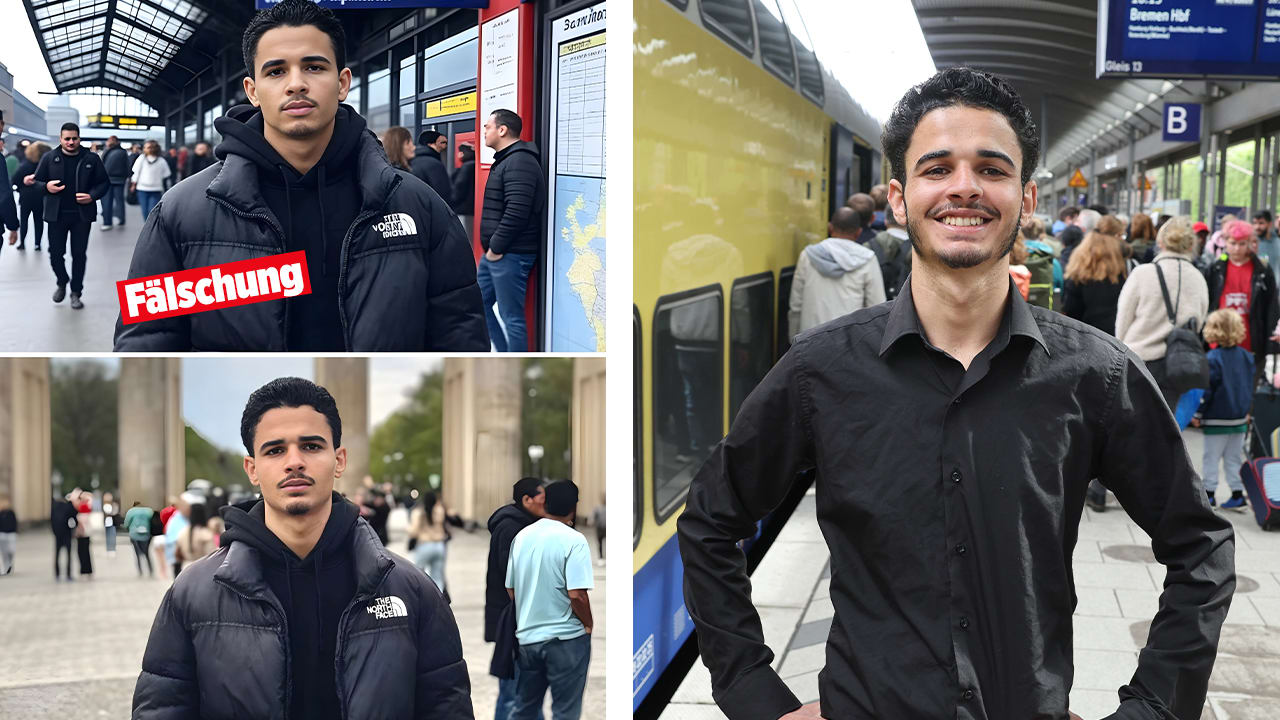
The response from the public was immediate. Many hailed Al Muhammad as a hero, celebrating his valiant efforts to protect others. However, not everyone shared this sentiment. A disinformation campaign emerged rapidly on social media, particularly on platforms like "X". Fabricated images began circulating, depicting Al Muhammad in unrealistic scenarios—showing him as heavily muscled in front of train schedules and even at an entirely different location like Sylt.
The Rise of Misinformation
The concept of misinformation is nothing new, but the instances of fabricated content, especially concerning real-world events, have surged recently. In Al Muhammad’s case, the emerging claims suggest that his story is invented, labeling him as a fictional character. A particular focus has been placed on the original photo of Al Muhammad standing at the Brandenburg Gate in Berlin, which came from his personal collection and was taken long before the incident in Hamburg.
Each edited image bears a clear hallmark of artificial intelligence manipulation. Perhaps more alarming is that such alterations, characterized by distortions and odd typographical errors—such as the brand logo appearing garbled—are being mistaken for legitimate photographs. This highlights a trend where internet users are either uninformed or dismissive of how fabricated visuals can distort public perception.
Insights into the Media’s Role
Despite the viral spread of these counterfeit images, reputable news organizations have refrained from disseminating this misleading content. However, there are right-wing accounts propagating the narrative that the media has fabricated the story. Contrary to these claims, the evidence points towards both the legitimacy of Al Muhammad’s actions and the baselessness of the counter-narratives.
The integrity of news sources plays a crucial role in shaping public opinion and countering misinformation. Journalists must strive for transparency and ensure that their reporting is grounded in fact-checking and evidence-based information. It is disheartening to see the crucial work of a brave individual overshadowed by a wave of conspiracy theories.
Recounting the Hero’s Experience
Recently, Marco Zitzow, the chief reporter for BILD, had the opportunity to meet Al Muhammad at the scene of the incident. In his recounting, he emphasized the gravity of the incident, highlighting how Al Muhammad stood in the smoking area when pandemonium unfolded.
“I may not speak very good German yet, but I made it clear: ‘If you get up, I will hit you,’” Al Muhammad said during his interview, illustrating his resolve in that critical moment.
After the attack, he voiced concerns about public safety, suggesting, “The police should have more authority to conduct checks. For knife attacks, we need stricter penalties.” These words reflect not only his bravery but also a broader societal concern regarding public safety in crowded places.
Conclusion
In sum, Al Muhammad’s courageous act during a moment of crisis underscores the profound impact one individual can have in a harrowing situation. However, the eruption of false narratives about his heroism serves as a reminder of the broader challenges we face regarding truth and deception in the digital age. Al Muhammad’s valor is real, while the AI-generated images intended to undermine his story remain nothing more than a fabrication of misunderstanding and prejudice.
Hamburg – Ein junger Syrer rettet Dutzende Menschen, riskiert dabei sein eigenes Leben. Jetzt wird er selbst zur Zielscheibe.
Beim Messerangriff im Hamburger Hauptbahnhof am Freitagabend überwältigte der 19-jährige Muhammad Al Muhammad gemeinsam mit einem weiteren Passanten die 39-jährige Angreiferin – und verhinderte so, dass noch mehr Menschen verletzt werden.
Doch im Netz rollt seit gestern eine perfide Desinformationskampagne: Vor allem auf „X“ tauchen plötzlich eindeutig mit Künstlicher Intelligenz erstellte Fotomontagen auf – sie zeigen den Syrer deutlich muskulöser vor einem Hamburger Fahrplan, einmal sogar auf Sylt. Immer wieder versehen mit derselben Unterstellung: Die Heldengeschichte sei frei erfunden, eine Medienlüge. Diesen Mann gebe es gar nicht!
Fakt ist: Die zugrunde liegende Originalaufnahme, auf der Muhammed Al Muhammad in Berlin vor dem Brandenburger Tor steht und die DER SPIEGEL zuerst veröffentlichte, stammt aus seinem Privatarchiv – lange vor der Attacke aufgenommen.
Woher die KI-Fälschungen kommen, ist unklar. Klar ist: Kein einziges seriöses Medium hat sie verbreitet. Doch genau das wird überwiegend von rechtsextremen Accounts behauptet und gestreut – mit großem Erfolg. Entsprechende Postings erreichen Hunderttausende.
Triumphierend werden dabei Hinweise auf KI analysiert. Dabei steht bei den kursierenden Motiven völlig außer Frage: Diese Bilder sind mit KI erzeugt, erkennbar zum Beispiel am verzerrten Logo der Kleidungsmarke „The North Face“. Typisch für KI, die gerade bei Buchstaben oft ins Stolpern gerät. Neuere KI-Modelle haben die Darstellung von Schriftzügen erheblich verbessert – insbesondere bei klar platzierten, frontalen Texten. Doch bei perspektivischen Verzerrungen, unregelmäßigen Oberflächen oder bewegten Szenen bleiben typografische Fehler weiterhin ein häufiges Erkennungsmerkmal.
Die Montage, die Desinformation verbreiten soll: Erkennbar ist der KI-Einsatz zum Beispiel am verzerrten Logo, aber auch an der Kauderwelsch-Schrift am Fahrplan und der Anzeigentafel über dem Kopf von Al Muhammad.
BILD-Chefreporter traf den Syrer am Bahngleis
BILD-Chefreporter Marco Zitzow rekonstruierte die fürchterliche Tat und traf Muhammad Al Muhammad an Gleis 13, wo alles geschah. Fotografierte und interviewte ihn.
„Ich habe im Raucherbereich gestanden, als plötzlich die Leute anfingen zu schreien“, erinnert sich der Mann, der 2022 vor dem Assad-Regime nach Deutschland flüchtete.
Er sah die Angreiferin: „Sie hatte ihre Kapuze heruntergezogen, rannte durch die Menge und stach mit einem langen Messer auf die wartenden Menschen ein.“ Gemeinsam mit einem Tschetschenen verfolgte er die Frau; der Mann stellte ihr ein Bein, Al Muhammad sprang auf sie, das Messer fiel ins Gleis.
„Ich spreche zwar noch nicht so gut Deutsch, aber dafür hat’s gereicht. Ich sagte: ,Wenn du aufstehst, ich schlage.‘“ Die Frau ergab sich, die Polizei nahm sie fest.
Zurück am Bahnsteig fordert der 19-Jährige: „Die Polizei sollte viel mehr kontrollieren dürfen. Für Taten wie Messer-Angriffe muss es härtere Strafen geben.“
Trotzdem verbreiten Verschwörungsgläubige weiter Fake-Shots und Memes, pöbeln „Wen wollt ihr verarschen?“ Offenbar passt es nicht in jedes Weltbild, dass ein junger Syrer eine deutsche Messerstecherin stoppt.
Al Muhammads Zivilcourage ist echt – die KI-Bilder sind es nicht.