
Shooting Stars from Space: Perseids through the Eyes of Astronauts
How do you see a fleeting star from the International Space Station (ISS) ? If it is already difficult to capture the persistent stars below, although there are guides for it, doing so from space — moving at 27,600 km/h — when the Perseids fall at eight times that speed and burn in a second demands incredible patience. Yet, at least three astronauts have managed to capture these fleeting moments: two Americans and one Russian, each with their unique style.
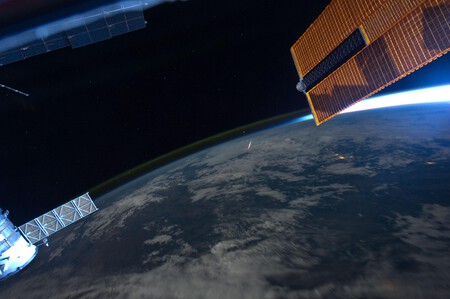
Image | Ron Garan, NASA
Ron Garan, a former NASA astronaut and flight engineer of Expedition 28, took this breathtaking photo on August 13, 2011 , during the Perseid meteor shower . The ISS was flying over China, roughly 400 kilometers northwest of Beijing, when Garan captured the brilliant flash of a meteor burning through the Earth’s atmosphere.
The photograph was no mere accident. Garan positioned himself in the ISS dome with his camera during the Perseid activity peak . The green and yellow glow that appears between the Earth and the void of space is the luminescence of the atmosphere: atoms and molecules that get excited by sunlight during the day and release energy at night, creating a stunning visual effect. The intense blue brightness beneath the solar panels of the station signifies dawn.
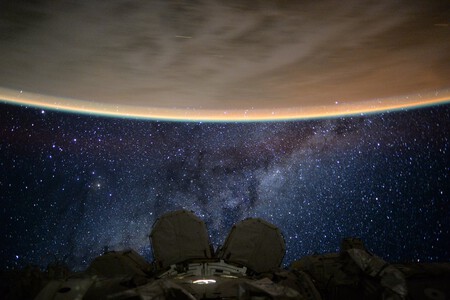
Image | Scott Kelly, NASA
Scott Kelly is known for his year-long stay in space, meant to compare his physical changes with those of his twin brother, Mark. During Expedition 44 on August 12, 2015 , Kelly took another stunning image capturing the trails left by the Perseids in long-exposure photos. With the absence of the Moon, the starry sky appears almost more captivating than our planet itself.
From the ISS’s perspective, which orbits the Earth at about 400 kilometers above the surface, meteors such as the Perseids streak beneath, heating up to incandescence. These bright grains of dust travel at about 60 kilometers per second , disintegrating at an altitude of around 100 kilometers above the Earth’s surface.
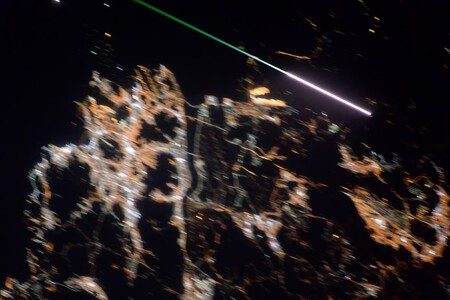
Image | Oleg Kononenko, Roscosmos
Oleg Kononenko, the Russian cosmonaut who has traveled to space five times and holds the record for most days spent in space (1,111), also captured a stunning photo of a Perseid meteor. He took this iconic image on August 9, 2024 from the International Space Station. While the background city may be slightly blurry, the level of detail captured of the fleeting star is remarkable.
Perseids are associated with their peak period in mid-August, where these meteors are particles expelled by the Swift-Tuttle comet . Each year, during this time, Earth passes through the debris left by this comet, leading to the fiery displays in the sky. The peak activity typically occurs around mid-August, but stargazers can see these meteors from late July until early August. This timing coincides with summer in the northern hemisphere, making the Perseids the most popular meteor shower.
In conclusion, the Perseids offer not just a mesmerizing natural spectacle but also a connection to the vastness of space and the incredible experiences of those who journey beyond our planet. With each photograph capturing the fleeting beauty of these meteors, astronauts like Garan, Kelly, and Kononenko remind us of the wonders of the universe that can be seen from above. Their stunning images serve as a celebration of both human ingenuity and the beauty found in the cosmos.