
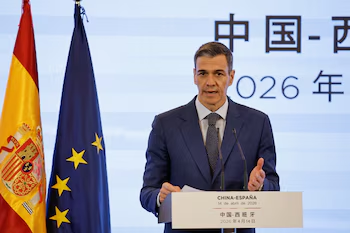
Pedro Sánchez’s Call for the Regularization of Migrants
A Historic Decision
On a significant Tuesday, Pedro Sánchez, the President of the Spanish Government, celebrated the forthcoming approval of an extraordinary regularization decree for migrants residing in Spain without legal status. He emphasized that this initiative marks a progressive step for Spanish society, made possible through the relentless efforts of hundreds of organizations and over six hundred thousand individuals who have championed this cause for years.
Public Support and Legislative Efforts
This monumental decision follows a popular legislative initiative (ILP) spearheaded by the Regularization Now movement, which gathered an impressive 700,000 signatures. Despite lacking sufficient political support at that time, the topic returned to the parliamentary agenda when a partnership between Podemos and PSOE reignited discussions in early 2026. The upcoming Council of Ministers’ approval reflects a long-awaited resolution to a pressing societal issue.
Normalization and Historical Context
Sánchez articulated that regularization represents an “act of normalization”, acknowledging the existence of nearly half a million individuals contributing to the enriched tapestry of Spain. He linked this decision to Spain’s own migratory past, recalling how previous generations faced adversity and emigrated in search of better opportunities. By relating current migrants to his ancestors, he underscored the deep-rooted historical connections that bind societies across borders.
The Necessity of Migrant Workers
Sánchez reiterated the critical need for migrant labor in Spain, especially amid an aging population and declining workforce. He asserted that without the integration of new workers, Spain’s growth, innovation capacity, and essential public services, including healthcare and education, face severe risks. He stated unequivocally that neither technology nor automation alone can address these challenges, elevating the call for a strategy that better integrates and organizes contributions from migrants.
Rights and Responsibilities
While stressing the importance of recognizing rights for migrants, Sánchez also emphasized the necessity for them to fulfill obligations. He advocated for an environment where migrants can coexist with citizens on equitable grounds, urging their active participation in preserving Spain’s societal fabric. His message resonates with the growing acknowledgment that integration must begin with regularization, paving the way for meaningful contributions from migrants that benefit everyone.
Addressing Challenges and Moving Forward
Acknowledging the multifaceted challenges that migration can present, Sánchez countered ant-immigration sentiments by suggesting that the path to resolution lies in regularization. He asserted that true integration arises from stable employment, systematic contributions, and full societal participation. Against those who propagate fear and division, Sánchez called for a perspective that sees migration as a reality that can be handled responsibly, with justice and mutual prosperity in mind.
Conclusion
Pedro Sánchez’s endorsement of migrant regularization echoes a broader societal push for inclusion and equity. By intertwining historical lessons with present-day necessities, this initiative stands as a beacon of hope for many individuals seeking recognition and opportunity in Spain. Through this significant step, the government not only rectifies past injustices but also lays the groundwork for a prosperous and inclusive future for all inhabitants of the nation.