
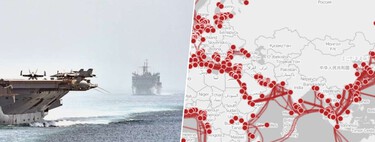
When international conflicts arise, opportunities often emerge for unexpected beneficiaries. Amid the ongoing Third Gulf War and its accompanying energy crisis, the Panama Canal has found itself in a lucrative position. The closure of the Strait of Hormuz, a pivotal artery for global oil and gas transport, has propelled the Central American nation into an economic bonanza.
The Mechanism of Urgency
In the wake of escalating tensions and blockades inHormuz, maritime traffic through the Panama Canal surged nearly 11%. According to the Panama Canal Authority, some days saw increases of up to 20%. Between October 2025 and March 2026, transits through the canal totaled 6,288, surpassing the previous year by 224 journeys.
This spike can be partly attributed to favorable weather conditions. Ilya Espino de Marotta, the canal’s deputy administrator, noted that heavy rainfall has ensured optimal water levels in Gatún and Alhajuela lakes, facilitating a rise to an average of 40–41 transits daily—significantly higher than the standard of 36. Despite past droughts during El Niño, the canal is currently functioning effectively amid global geopolitical complexities.
The pricing structure has also shifted dramatically. Ships initially paid fixed rates of $300,000 to $400,000 with reservations. However, companies unable to secure a reservation now navigate a competitive auction system. Average bids that were about $135,000 before the crisis have skyrocketed to approximately $385,000. Reports suggest that some oil companies are willing to pay over $3 million to avoid lengthy waits
A Logistical Lifesaver, Not a Replacement
The Panama Canal’s newfound profitability hinges on its geographical advantages. Prior to the closure of the Strait of Hormuz, over 80% of oil flow was directed toward Asian markets. With this route obstructed, countries like Japan, South Korea, India, and China are now sourcing crude oil from the U.S. Gulf Coast. Data indicates that U.S. crude oil exports via the Panama Canal are nearing record levels, exceeding 200,000 barrels per day.
The logistical advantages are clear. A journey through the canal from the Gulf Coast to Japan takes roughly a month, whereas a detour around the Cape of Good Hope could double that travel time. Amid missile strikes and air raids, companies express a growing preference for the safety and efficiency offered by the Panama Canal.
Despite the uptick in traffic, experts emphasize that the Panama Canal’s capacity is limited. During the first half of 2025, the Strait of Hormuz saw a staggering 20.9 million barrels of oil transiting daily—vastly overshadowing the 2.3 million that passed through the Panama Canal in its entire fiscal year.
From Economic Bonanza to Diplomatic Minefield
Panama’s sudden prominence has not gone unnoticed by global powers. Claims have emerged accusing China of selective economic pressure, particularly following the annulment of a concession linked to Hong Kong companies for ports in Panama. In response, Chinese officials have denied these allegations, framing them as unfounded and politically motivated.
As tensions mount, economists warn that any disruption in Canal operations could trigger significant volatility in global markets and lead to inflationary pressures. The geopolitical landscape has shifted dramatically, with nations increasingly viewing strategic waterways as potential negotiation tools.
Panama’s Economy, the Great Beneficiary
Financially, the canal’s success translates to substantial gains for Panama. According to the Constitution, surplus revenues from the canal are transferred to the National Treasury. In fiscal year 2025, the canal generated around $5.7 billion in revenue, which contributed approximately 3.4% to the nation’s GDP. Should earnings rise by 10% to 15% this year as projected, Panama will receive unanticipated financial resources.
However, this economic prosperity highlights critical vulnerabilities within the global trade framework. The prevailing reliance on narrow water passages for maritime transport exposes the interconnectedness—and fragility—of supply chains worldwide. As maritime routes become susceptible to geopolitical maneuvering, the implications for global trade may prove costly.
Image | Pexels