
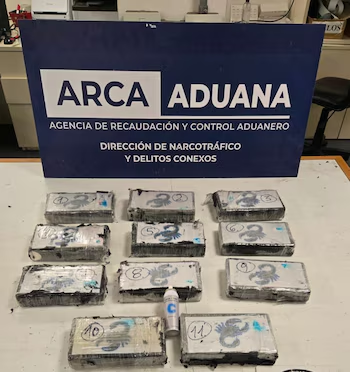
Major Cocaine Bust at Ezeiza: A Transnational Effort
A significant operation between Argentine and French authorities has successfully dismantled a criminal organization involved in international cocaine trafficking via air parcels. This collaborative effort utilized the critical tool of international monitored delivery, a strategy key to tackling transnational crime.
Discovery at Ezeiza International Airport
The case began on April 24, when agents from the General Directorate of Customs and the Airport Security Police (PSA) in Argentina detected a suspicious shipment at Ezeiza International Airport. Inside a plastic crate, customs officials uncovered 11 bricks of cocaine, vacuum-packed and marked with a distinctive scorpion symbol often used by drug trafficking organizations. The total weight of the seized cocaine exceeded 11 kilograms, with an estimated street value of over USD 165,000.
The Strategy of Controlled Delivery
Rather than simply seizing the narcotics, Judge Marcelo Ignacio Aguinsky authorized an international monitored delivery. This approach allowed the shipment to proceed under strict judicial and operational oversight, aiming to identify the members of the criminal network in the destination country.
International Collaboration and Subsequent Raids
Immediate international cooperation ensued, as French customs officials coordinated actions with their Argentine counterparts, further involving the French National Directorate of Intelligence and Customs Investigations (DNRED) and security personnel from Air France.
During the investigation, a second suspicious shipment was intercepted, containing over 12 kilograms of cocaine hidden in an air compressor. The bricks were cleverly concealed with a kind of paraffin to evade detection by customs and drug-sniffing dogs.
Investigative efforts unearthed connections between both shipments, revealing similarities in tactics and suspects involved. Authorities identified two French citizens, linked to the operation, and subsequently issued international arrest warrants against them.
Arrests in Europe and South America
On May 1, the cocaine shipments were placed onto an Air France flight headed for Europe, still under the watchful eye of authorities. The following day, the packages arrived in Paris, where the DNRED took over for the operational phase of the controlled delivery.
As part of the same operation, Uruguayan officials arrested two French nationals—Isaac Ben Daoune (37) and Ahmed Adda Belkocir (47)—in Montevideo as they attempted to return to Argentina using forged documentation. Both individuals were subjects of a red Interpol notice initiated by Judge Aguinsky.
Ongoing Investigations and Future Implications
In the wake of these events, further raids took place in Buenos Aires, leading to the seizure of electronic devices, cash, documentation, and other critical materials related to the case. On May 6, authorities in Paris arrested another key suspect tied to the organization.
Experts note that international controlled delivery is a vital instrument for dismantling complex criminal networks, as it reveals the true orchestrators and financiers behind drug trafficking operations. The investigation remains active, with more arrests anticipated both in Argentina and Europe.
This joint operation exemplifies how international cooperation can yield significant results in the fight against drug trafficking, hitting criminal organizations hard and shedding light on the darker corners of global drug trade.