
Last week witnessed significant developments in Spanish foreign policy , marked by the decision of Prime Minister Pedro Sánchez to send the Maritime Action Furor P-46 to protect the Global International Flotilla Sumud . This mission represents a critical pivot for Spain, which is now actively engaging in international humanitarian efforts in the Eastern Mediterranean. A few hours later, another major decision emerged: Spain has decided to veto the transit of U.S. weapons to Israel, signaling its intent to prioritize humanitarian concerns in the ongoing Israel-Palestine conflict.
Solidarity and Geopolitics. The deployment of the Furor P-46 is pivotal considering the background of the Global International Flotilla, comprising over fifty civil vessels carrying activists from 45 countries , including renowned figures like Greta Thunberg and Ada Colau. This initiative aims to deliver aid to Gaza and to symbolically break the enduring Israeli naval blockade, especially exacerbated by drone attacks previously faced in Greek waters. With an estimated 65,000 Palestinian casualties since the Israeli offensive began in October 2023, the Spanish government’s gesture holds significant political and moral weight . Sánchez voiced his concerns at the UN General Assembly, emphasizing that Spain would not remain passive in the face of such a catastrophic humanitarian crisis.
<img alt="In his fight against mass tourism, Italy has entered an unexplored land: a tax on tourist dogs" width="375" height="142" src="https://i.blogs.es/b91a66/photo-1711140694666-3719a4d75fae/375_142.jpeg"/>The Furor P-46 in Front of the Italian Response. Spain’s deployment starkly contrasts with Italy’s response under Prime Minister Giorgia Meloni, who has criticized the mission as “unnecessary and dangerous”. Yet, Italy sent two frigates , the Virginio Fasan and Alpino , both equipped with advanced combat capabilities. In contrast, the Furor P-46 is a smaller maritime action ship, weighing 2,840 tons and measuring 93.9 meters in length, manned by fifty-one crew members. It is equipped with a 76 mm cannon and two MK-38 machine guns . While the military capability of the Furor P-46 may be limited compared to the Italian frigates, its mission is more about symbolic protection of civilians and adherence to international law.
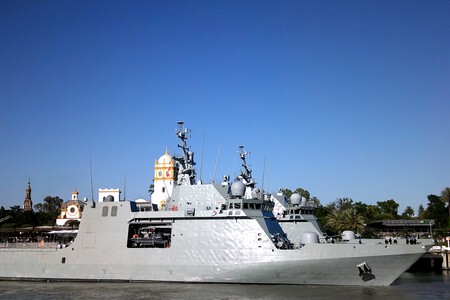
The Furor P-46
A Historical Veto. The other significant aspect of Spain’s strategy is its veto on the passage of U.S. arms through the bases at Rota and Morón for Israel. Although a bilateral defense agreement from 1988 allows the U.S. extensive prerogatives for base use, Madrid maintains the final say and has exercised clauses prohibiting “controversial loads”. This decision has led to alternative routes being taken by Israeli F-35 fighters, diverting towards the Azores, and has even affected the logistics of Israeli Prime Minister Benjamin Netanyahu , who had to navigate a more complicated route to attend UN meetings, avoiding Spanish airspace.
This development represents a decisive moment, showcasing Spain’s commitment to asserting its sovereignty over strategic infrastructure while not breaking its long-standing alliance with the U.S. Historical comparisons reveal that, back in 2002, former Prime Minister José María Aznar had cooperated closely with U.S. agendas during the Iraq invasion, a move that later resulted in significant domestic backlash. In contrast, today’s government appears focused on navigating an independent path, particularly regarding the politically sensitive issues surrounding Gaza.
Historical Comparison: From Iraq and Libya to Gaza. Spain’s current stance inevitably evokes memories of its past foreign policy decisions. In 2003, Aznar’s government aligned with U.S. and UK forces in Iraq, generating widespread discontent and leading to political fallout. A decade later, during the Zapatero administration , Spain participated in NATO’s military interventions in Libya, which were framed as humanitarian missions. These two instances reflect Spain’s previous tendency to prioritize loyalty to NATO and U.S. foreign policy over national character in international conflicts. In contrast, the actions of the Sánchez administration stand as a bold statement against being a mere supporter in global theaters.
The Mediterranean as a Geopolitical Landscape. The Eastern Mediterranean is increasingly recognized as a critical geopolitical arena where multiple national interests converge. By sending the Furor P-46 and imposing a veto on U.S. military support for Israel, Spain aims to position itself as a significant Mediterranean power with an independent agenda, moving away from being a follower of U.S. confrontational policies.
The actions to deploy the Furor P-46 and enforce the veto represent both a humanitarian stance and a diplomatic strategy, as Spain now claims the role of a mediator and advocate for peace in a turbulent region. This forms part of the larger objective to restore Spanish influence and redefine its standing within both the Mediterranean sphere and European political discourse. Through these initiatives, Spain demonstrates a commitment to humanitarian values while also asserting its identity as an independent nation committed to international law.

Giro and Projection. The combination of Spain’s current measures signifies a potential shift in its foreign policy landscape. No longer merely a secondary player during interventions in Iraq and Libya, Spain is now stepping into a proactive role in the Gaza region and outlining a strategy that balances humanitarian support, the defense of international law, and the assertion of sovereignty in its military partnerships. The Sánchez administration appears keen to align its diplomatic positioning more closely with European sensibilities, thereby seeking to carve a unique moral authority while maintaining the complexities of international relationships.
In summary, Spain is navigating a transformative phase in its diplomatic relations, where the new directions symbolize a broader intent to reshape its international identity and focus on humanitarian concerns while preserving strategic autonomy in the complex world of global politics.