
The OpenClaw Moment: A Double-Edged Sword
In 2025 we had a ‘DeepSeek moment,’ and in 2026, we are experiencing an ‘OpenClaw moment.’ OpenClaw, a powerful AI agent, is offering remarkable capabilities but comes with significant cybersecurity risks. Fortunately, the Spanish cybersecurity company VirusTotal has partnered with OpenClaw to help mitigate these vulnerabilities associated with its skills.
What’s Happening with OpenClaw?
OpenClaw—which has evolved from its previous names, Moltbot and Clawdbot—has launched a collaboration with VirusTotal, a subsidiary of Google based in Malaga. This partnership will see VirusTotal scanning and analyzing “skills,” which are akin to plugins that enhance OpenClaw’s functionality. However, some malicious entities exploit this opportunity to incorporate harmful instructions capable of stealing data and hijacking other AI agents.
Enhanced Security Measures
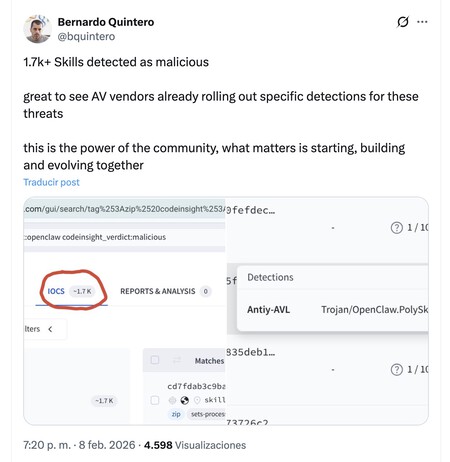
Peter Steinberger, the creator of OpenClaw, has embarked on this journey with cybersecurity veteran Jamieson O’Reilly from Dvuln and Bernardo Quintero, founder of VirusTotal, aiming to fortify the OpenClaw community’s security. According to an official announcement, all skills published in ClawdHub, the official skills store, will now be scanned by VirusTotal’s advanced Threat Intelligence system, including its novel Code Insight feature. Quintero even revealed on Twitter that 1,700 skills have already been identified as malicious.
Blocking Malicious Skills
Through this collaboration, VirusTotal’s tools not only identify malicious skills but also immediately block them from being downloaded. Moreover, skills deemed benign undergo daily analyses to detect any future potential for malicious actions. While these measures significantly enhance security, the OpenClaw team cautions that VirusTotal’s scans are not foolproof; sophisticated attacks like prompt injection can still pose risks.
OpenClaw’s Commitment to Security
The initiative is part of OpenClaw’s broader strategy to establish a comprehensive cybersecurity model that includes a detailed public roadmap for future developments, formal communication channels, and a commitment to rigorous code audits.
Addressing Potential Threats
Initially, OpenClaw became a viral sensation for its unique capabilities, but a quick security audit revealed a worrying 341 malicious skills among an initial batch of 2,851. Tools like AI Skills Checker from companies such as BitDefender have also emerged to address these issues. Malicious skills can execute shell commands, allowing hackers full control over the victim’s machine.
Understanding the Attack Vector
Cybersecurity attacks are traditionally complex, but the unique nature of AI agents like OpenClaw introduces a vulnerability in natural language processing. Rather than relying on intricate code, attackers can bypass security by simply “convincing” the AI through seemingly harmless language prompts. Such techniques can enable unauthorized access to sensitive information, including personal data and API keys.
Staying Vigilant with OpenClaw
While the partnership with VirusTotal reduces some risks, users should remain cautious when implementing OpenClaw. Comprehensive guides are available to assist in secure installation, and the project team has provided recovery commands like openclaw security audit --deep --fix to help audit and remediate security issues.
In summary, while OpenClaw and its new partnership with VirusTotal present exciting opportunities, they also highlight the importance of vigilance and robust security measures in the realm of AI technology.