
OpenAI Launches GPT-Oss: A New Era for Open AI Models
OpenAI’s recent announcement of GPT-Oss has sent ripples through the AI community, rekindling the spirit of accessibility that many believed was lost. For years, OpenAI had moved toward a more closed ecosystem, especially following the debut of ChatGPT in November 2022. With that launch, they ceased to release open-weight models, marking a significant shift from their initial vision of open collaboration. GPT-Oss represents the first open-weight model since the release of GPT-2 in 2019, and it comes at a time when many were anticipating the imminent arrival of GPT-5.
What exactly is GPT-Oss? In simple terms, it is a language model developed by OpenAI, crafted to understand text instructions and provide coherent, context-rich responses. It shares its origins with the GPT family, the same technology that birthed ChatGPT. However, the key feature that sets GPT-Oss apart is its open weights, allowing anyone to download, run, and modify it to meet their unique requirements.
For the first time in several years, OpenAI has unveiled a robust model independent of its platform. This means users can run the model without an internet connection, customize it to their needs, and do so entirely for free. This development opens doors for developers, small businesses, and tech enthusiasts to explore AI on their own terms.
Understanding Open Weights and Their Implications
When we refer to open weights , we are discussing the internal numerical values that the model has learned during its training phase. These weights encapsulate the model’s knowledge and capabilities, enabling reasoning , writing, translating, and generating functional responses. The release of these weights suggests anyone can download and analyze them, allowing for execution in personal environments. While this does not equate to the availability of full source code or training data, it is a pivotal step toward openness in AI.
Is GPT-Oss Truly Open?
While GPT-Oss emphasizes open weights, it’s essential to clarify that it is not entirely “open source” in the conventional sense. OpenAI has not released the complete data or the entire training process used for GPT-Oss. Instead, it has kindly shared the model’s learned parameters under the Apache 2.0 license, which allows for flexibility in its use within specific limits. Thus, this is why it is referred to as an open-weight model rather than fully open-source, as highlighted by organizations like the Open Source Initiative (OSI) .
Availability and Usage
For potential users asking, “ Can I run it on my laptop? ”, the answer is somewhat conditional. GPT-Oss comes in two variants: a heavy model with 120 billion parameters and a lighter version with 20 billion parameters . The more powerful variant demands a GPU with at least 80 GB of memory, suitable for professional settings. In contrast, the 20 billion parameter model is more accommodating; it can operate on machines with 16 GB of memory, making it an appealing choice for personal laptops and desktops.
You can find the necessary tools for running GPT-Oss, such as LM Studio, flame.cpp , or Vllm , which allow you to test the software locally instead of relying on cloud services. However, it’s recommended that users have some technical prowess to set up and operate these models effectively.
Where to Download GPT-Oss
If you’re eager to explore GPT-Oss, you can download the model’s weights for free. The best place to access them is via Hugging Face or through cloud platforms like Azure, AWS , or Databricks . Both model variants, along with comprehensive documentation, are readily available.
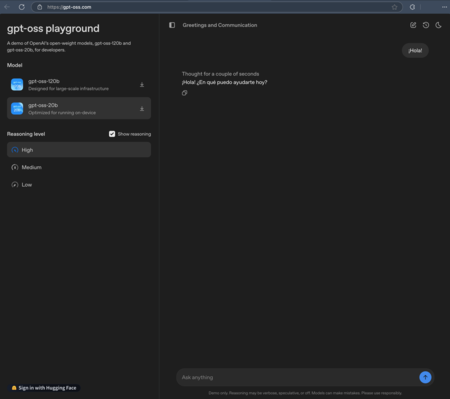
OpenAI has also facilitated a free testing website at GPT-oss.com, allowing users to interact with the models without needing to install them. You can select between GPT-Oss-120B and the lighter 20B model, tweaking the reasoning capabilities to suit your tasks. This interface provides a fantastic opportunity for users to gauge the model’s capabilities before diving into the download.
Ease of Use
Utilizing GPT-Oss isn’t overly complex, but it doesn’t boil down to simply clicking a few buttons either. The models come with clear instructions and are integrated into platforms like LM Studio or Llama.cpp for straightforward local execution. However, a basic understanding of concepts such as execution environments and model loading is necessary. If you’ve previously interacted with open-weight models, you’ll find the process manageable; otherwise, guidance is available, but expect some learning time for successful deployment.
Capabilities of GPT-Oss
What can this model accomplish? GPT-Oss boasts multifaceted functionality : it can reason, generate text, write code, answer queries, and even perform searches. Additionally, it integrates with external tools, such as Python interpreters , so it can operate in more automated workflows as well. OpenAI claims that the 120B variant’s performance in reasoning tasks is comparable to O4-MINI, while the 20B version stands alongside O3-MINI in common benchmark tests, showing commendable results in programming and reasoning capabilities.
While GPT-Oss may not be the most powerful model from OpenAI, its versatility and accessibility mark a significant shift in the landscape of AI technologies. Users can leverage its potential without financial constraints or reliance on API services.
In an era where closed models are becoming the norm, the arrival of GPT-Oss not only restores hope for open-source AI but also opens exciting avenues for innovation and creativity across various fields.