
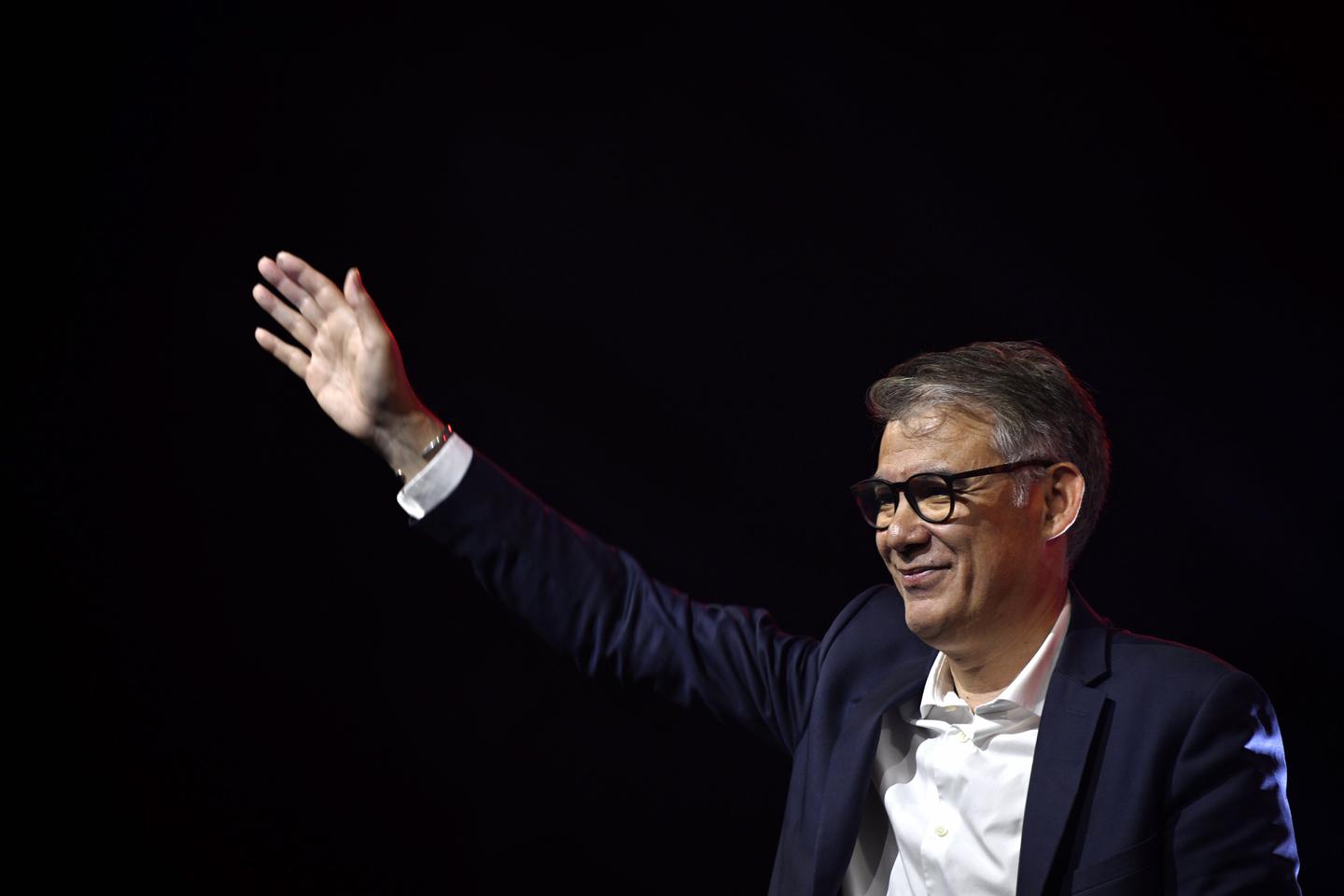

The Socialist Party (PS) announced on Friday, June 6, that Olivier Faure has won the tight race against Nicolas Mayer-Rossignol to secure a fourth term as the party’s first secretary. Despite pending results from several federations, it was confirmed that Faure received 50.9% of the votes compared to 49.1% for the mayor of Rouen.
“On Thursday, June 5, following a close ballot, Olivier Faure was re-elected as the first secretary of the Socialist Party,” stated a PS communiqué. A verification commission, aimed at validating the results, commenced overnight among members from both camps, with final figures expected by the day’s end. The official results will be ratified at the congress set to take place in Nancy (Meurthe-et-Moselle) from June 13 to 15.
“Thank you to the activists who renewed their trust in me tonight,” Faure expressed on X. “Starting tomorrow, we will continue the work initiated in 2018 to enhance the momentum, with a Socialist Party rooted in the heart of the left.”
During the night, Faure’s aides suggested a score of around 52% in his favor, approximately 500 votes ahead, stating these were insurmountable. Conversely, Mayer-Rossignol’s team disputed this claim, emphasizing it was too early to declare a victor.
Support from Boris Vallaud for Olivier Faure
From 5 PM to 10 PM on Thursday, about 40,000 party members were called to decide between Olivier Faure and Nicolas Mayer-Rossignol for the party’s leadership, just as they did in 2023.
Seine-et-Marne deputy, Olivier Faure led the first round with 42.21% against Mayer-Rossignol’s 40.38% . In the first round, 24,701 members cast their votes. The incumbent first secretary advocates for a broad left union, excluding Jean-Luc Mélenchon, for the 2027 presidential elections, pursuing a joint candidacy from various factions, including Raphaël Glucksmann and François Ruffin.
Third-place candidate Boris Vallaud, with 17.41% of the votes, aligned himself with Faure’s strategic vision. He previously stated in an interview with *Le Monde* that he would personally vote for Faure but declined to provide marching orders for his supporters. He warned that his choice should not be interpreted as “a blank check or a magic slate” for Faure, who has led the party since 2018 and has faced criticism for internal discord.
Accusations of “Clan management”
“Boris Vallaud said he wanted change, yet he chooses Faure. Where’s the consistency?” queried an opponent of the incumbent. Mayer-Rossignol envisions a “grand Socialist Party” uniting socialists and allied factions, including Glucksmann and Bernard Cazeneuve.
This coalition contends that Olivier Faure’s leadership is characterized by “clan management” and “ambiguities” regarding Jean-Luc Mélenchon and the “insoumis” , despite Faure’s recent distancing from alliances he formed in 2022 under the Nupes umbrella and with the New Popular Front (NFP) in 2024.
“I have no regrets about what we achieved,” Faure retorted, highlighting that when the NFP led the anticipated legislative elections in 2024, “Mayer-Rossignol didn’t view it as a folly.”
Mayer-Rossignol also criticized Faure for using the congress as a stepping stone for presidential ambitions . “This congress is not meant to designate a candidate for 2027,” Faure replied. Two years ago, the congress in Marseille fractured the party due to allegations of voting irregularities involving the same candidates.
The recent elections within the Socialist Party illustrate the complexities and divisions that persist in its ranks. With Faure’s re-election barely eclipsing Mayer-Rossignol’s challenge, it remains to be seen how these dynamics will unfold leading up to future political contests. While Faure has promised to solidify the party’s position within the left, discontent lingers among factions calling for reform. It is a critical moment for the Socialist Party, whose future will depend on how effectively it can unite its members and address the challenges ahead.
General News – 2