
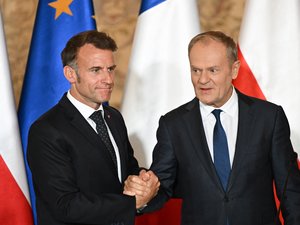
Emmanuel Macron and Donald Tusk have significantly strengthened Franco-Polish cooperation during their recent summit in Gdansk. This pivotal meeting focused on key defense initiatives, including advancements in nuclear deterrence and a new industrial agreement for military satellite development. The collaboration underscores the growing unity between the two nations in response to contemporary European security challenges.
Key Takeaways from the Gdansk Summit
Macron and Tusk have revitalized military cooperation, marking the first actionable steps in line with the friendship treaty signed on May 9, 2025, which elevates Poland’s status among France’s primary allies.
Both nations are pushing for tangible advancements in nuclear deterrence by summer 2025. This includes joint military exercises, enhanced information exchanges, and potential deployments of French nuclear-capable aircraft in Poland.
In addition to military cooperation, Macron expressed strong support for France’s EDF in the bid for Poland’s second nuclear power plant, while also acknowledging the recent political shift in Hungary toward a more pro-European stance.
A Deepening Military Partnership
During the summit, Macron highlighted the intention to foster cooperation in nuclear deterrence, stating, “There will be work between now and the summer which will allow us to move forward with concrete progress.” This partnership aims to enhance Polish capabilities through joint exercises and logistical support, including surface-to-air defense systems and early warning technologies.
Donald Tusk echoed this sentiment, emphasizing that their collaboration “knows no limits.” This expression of commitment indicates a robust framework for future military engagements aimed at bolstering European security in an increasingly unpredictable landscape.
Industrial Collaboration on Military Satellites
An industrial agreement was signed among major European firms—including Airbus and Thales—and Poland’s Radmor for the development of a geostationary military telecommunications satellite. This partnership signifies a step towards enhancing Polish defense capabilities and paving the way for advanced military technologies.
Poland’s Military Modernization Efforts
Significantly, Poland has invested heavily in modernizing its armed forces, with military spending expected to exceed 4.8% of its GDP by 2026. These investments include substantial orders for advanced military hardware such as F-35 jets, Apache helicopters, and Patriot missile systems, showcasing Poland’s commitment to strengthening its defense posture within NATO.
Despite these advancements, Poland’s recent political landscape remains complex, highlighted by Nationalist President Karol Nawrocki’s reluctance to participate fully in European defense initiatives. Nevertheless, the renewed leadership under Tusk signals a pro-European pivot that fosters improved ties with France and other EU nations.
Broader European Political Context
The summit took place amidst a backdrop of shifting political dynamics in Europe. Macron expressed optimism regarding the potential for releasing a €90 billion European loan to Ukraine, particularly following Hungary’s recent return to a pro-European stance after the electoral defeat of Viktor Orban.
This political shift also allows Tusk and Macron to collaborate on bolstering both defense and energy sectors in Poland. Macron reiterated France’s interest in nuclear energy, stating, “We know how to go from upstream to downstream of the cycle,” emphasizing EDF’s capabilities in providing a sustainable energy solution.
The Path Forward
As France and Poland continue to deepen their partnership, both leaders have committed to exploring cultural ties with plans for a cross-cultural season in 2027. By fostering strong relationships grounded in mutual defense and shared values, both countries aim to create a more united front in navigating future challenges.
In conclusion, the Gdansk summit marks a significant milestone in Franco-Polish relations, reinforcing their roles as pivotal allies in addressing contemporary security challenges while setting a course for future collaboration.