
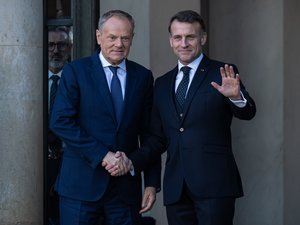
President Emmanuel Macron and Polish Prime Minister Donald Tusk are meeting this Monday in Gdansk to strengthen bilateral military cooperation. This summit, focused on “advanced” nuclear deterrence, the defense industry, and satellites, aims to assert Europe’s sovereignty in the face of tensions with Russia and the United States.
Key Highlights of the Gdansk Summit
- This Monday, April 20, Emmanuel Macron and Donald Tusk met in Gdansk to consolidate military cooperation and bolster European sovereignty, following the friendship treaty signed on May 9, 2025, in Nancy.
- The summit centered on nuclear deterrence strategies, including joint military exercises and Poland’s role in early warning systems, alongside plans for a cooperative European military communications satellite.
- Discussions also covered the concept of “European preference” in defense armaments, the tender for a second Polish nuclear power plant sought by EDF, and the announcement of cross-cultural initiatives for 2027.
Nuclear Deterrence: A Central Focus
The Gdansk summit marked an essential step forward in discussions about “advanced” nuclear deterrence—a concept proposed by Emmanuel Macron in March for eight European nations, with Germany and Poland taking the forefront. The potential for joint military exercises, combined with the stationing of French nuclear-capable aircraft among European allies, highlights the growing military collaboration aimed at combating external threats.
French President Macron, joined by key ministers from the Ministry of Defense, Foreign Affairs, Energy, and Culture, emphasizes the seriousness of this summit in the context of global security dynamics.
Poland’s Significant Involvement
Discussions included the possibility of “conventional participation” from Polish forces in French deterrent operations, albeit with France retaining sovereign control over military engagements. Poland’s involvement could enhance capabilities in areas such as early warning systems, air defense, and potentially even deep strikes in nuclear scenarios.
The Idea of “European Preference”
A pivotal topic at the summit was the concept of “European preference” concerning defense procurement. Macron has actively campaigned for a more unified European approach to defense, which raises concerns among some Eastern European allies who prioritize their ties with the United States.
The proposed partnership on a “military communications satellite” aims to enhance joint capabilities not only for France and Poland but also for other European nations. This effort is poised to bolster regional cooperation amid rising security threats.
Broadening the Agenda: Culture and Energy
In addition to defense discussions, leaders are expected to address cultural and energy collaborations. Notably, Poland has rapidly modernized its military, with expenditures projected to reach over 4.8% of its GDP by 2026—one of the highest rates in NATO. The summit also symbolizes a renewed commitment between France and Poland, especially in light of recent political shifts within the EU.
Furthermore, cultural ties will be strengthened through the announcement of a cross-cultural season for 2027, paving the way for deeper connections beyond military and defense initiatives. Additionally, EDF aims to secure a position in the anticipated tender for a second Polish nuclear power plant, underscoring France’s commitment to bolstering energy ties as well.
Conclusion
The Gdansk summit represents a crucial moment in Franco-Polish relations, emphasizing military cooperation and European sovereignty in a world marked by geopolitical tensions. As the two leaders collaborate to reinforce regional security, the implications of this partnership resonate beyond mere defense strategies, shaping the future trajectory of European unity in the face of growing global challenges.