
The Lizeth Marzano Case: Notary Donato Carpio Speaks Out
In a significant turn of events surrounding the tragic accident that claimed the life of athlete Lizeth Marzano, notary Donato Carpio Vélez has vehemently denounced the authenticity of a donation document allegedly connected to the defense of Marisel Linares and Adrián Villar. Carpio has stated that the document, purportedly evidencing a vehicle donation, is entirely false.
Allegations of Forgery
Carpio’s firm stance came after claims surfaced that a donation document, presented at his notary’s office, was tied to the vehicle involved in the fatal incident. He expressed his dismay, revealing that his records show no procedures related to this document. The notary indicated that the seal depicted in photographs circulating online does not originate from his office but has instead been altered in a way that constitutes forgery.
Critical Inconsistencies
The controversy surrounding this document deepens as the vehicle’s ownership remains registered under Marisel Linares. Importantly, Carpio pointed out that the document was not prepared as a public deed, nor does it possess any proof of payment for the essential notarial services. This lack of documentation raises questions about the legitimacy of the claims made.
Moreover, Carpio’s office confirmed there are no receipts, invoices, or any official records to substantiate the completion of the alleged donation procedure. In addition, no biometric queries with RENIEC—the official registry for identity—were recorded, which is typical in such certifications.
Dialogues of Doubt
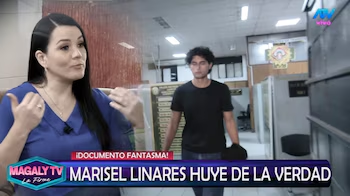
In an interview with Magaly Medina, Carpio articulated his confusion over the defense lawyer Elio Riera’s assertions that the document had been processed at his office. The notary was taken aback by the claim and subsequently reviewed all his files, finding no related records. He underscored that thus far, he has only encountered images from social media, not the original document.
Despite Carpio’s clarifying statements, Riera and Linares insist that this document has validity, even if the public registration process was incomplete. This contradiction continues to fuel public debate over the document’s credibility and the accessory legal nuances surrounding it.
The Lack of Formal Documentation
Further complicating matters, Carpio highlighted the absence of any appointment requests or follow-up communications regarding the document. He expressed frustration that no individuals connected to presenting the document had come forward to explain or clarify the situation. Moreover, he commented on the lack of formal payment proof for the notarial service, which contradicts standard procedural practices.
Distinctive Examination of the Seal
When asked to confirm whether the seal on the document belonged to his notary office, Carpio was definitive: “That seal is forged.” He elaborated that the seal reflects a notarial letter receipt and has been manipulated, particularly criticizing the use of the term “notarial code,” which he noted is not part of established notarial terminology. Given his extensive experience, he emphasized that the typical term used is “cardex,” which further confirms the document’s inauthenticity.
Conclusion
In light of these revelations, Donato Carpio Vélez’s public statements highlight significant anomalies surrounding the purported donation document linked to the tragic accident involving Lizeth Marzano. As the legal framework surrounding the case continues to unfold, Carpio’s commitment to integrity and transparency in notarial affairs remains paramount, positioning him as a pivotal figure in this distressing narrative. The layers of deception and the need for clarity in legal documentation serve as a stern reminder of accountability within the legal system.