
Escalating Tensions: North Korea’s Response to U.S., Japan, and South Korea Military Exercises
The geopolitical landscape in East Asia is witnessing a significant increase in tension as recent military maneuvers involving the United States, Japan, and South Korea have drawn sharp criticism from North Korea. The North Korean Ministry of Defense has labeled these exercises as provocative and indicative of a deteriorating security situation that could escalate at any moment into a military confrontation.
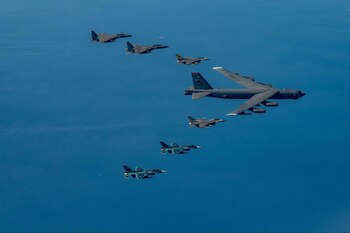
On Friday, the South Korean government confirmed that a series of military exercises took place in international waters near Jeju Island, involving at least one American B-52H strategic bomber, alongside South Korean Kf-16 and Japanese F-2 fighters. These exercises mark the first deployment of U.S. bombers in the region this year, and their presence is seen by Pyongyang as emblematic of an aggressive military strategy.
“Tripartite military cooperation” between the United States, Japan, and South Korea is increasingly viewed by North Korea as a direct threat. The Ministry of Defense for the North accused the involved nations of conducting hostile acts that exacerbate the already tense military environment on the Korean Peninsula. In an official statement, they expressed their “deep concern” over the continual military activities that they perceive as both provocative and threatening.
North Korea’s response also included a warning that prolonged instability in the region could lead to an “unpredictable phase of military confrontation.” Referring to these drills as “provocative military actions,” the North expressed its sovereign right to take countermeasures against such initiatives. They argue that the strengthened military alliances and joint exercises conducted under an aggressive banner fundamentally threaten the security of the region.
The geopolitical implications of these statements cannot be overstated. As tensions rise, stakeholders in the region and internationally are left to ponder the implications of a potential military confrontation. The historical context of North Korea’s relationships with its neighbors and the United States shapes this situation, and understanding these dynamics is critical for anticipatory diplomacy and conflict resolution.
The underlying motivations for North Korea’s vehement response can be traced back to a history of perceived marginalization and hostility from the West. The nation remains committed to its nuclear arsenal as a central aspect of its defense strategy. Any enhancements to multilateral military cooperation by the U.S., Japan, and South Korea are seen through the lens of threat, heightening North Korea’s sense of insecurity.
The international community is observing these developments carefully. The United Nations and nations globally have urged restraint and dialogue as the best method for de-escalating the situation. South Korean officials maintain that these exercises are defensive in nature, aimed at improving preparedness against any potential aggression from the North. However, without effective communication channels, the risk of misinterpretation and unintended escalation remains high.
Historically, North Korea’s reaction to joint military exercises has been to ramp up its own military demonstrations. This pattern suggests a cyclical nature of heightened military readiness, where each side’s actions are met with counteractions from the other. The question remains whether any further measures will be taken by North Korea in response to these most recent exercises. Observers are particularly curious if the North might conduct missile tests or other military displays as a show of strength.
The complex interplay of alliances in Asia means that the actions of one nation inevitably influence the stability of others. While the rhetoric currently being exchanged may seem hyperbolic, each statement and action can have significant ramifications. Heightened military readiness on either side increases the risk of miscalculation, making diplomatic engagement more essential than ever.
As the situation continues to unfold, one thing remains clear: the volatile environment on the Korean Peninsula necessitates no small amount of caution and strategic thinking from all parties involved. Diplomatic channels should be prioritized to navigate these turbulent waters, and a commitment to multilateral dialogue may hold the key to reducing tensions and fostering a peaceful resolution.