
Sheinbaum’s Firm Stance on Legal Accountability
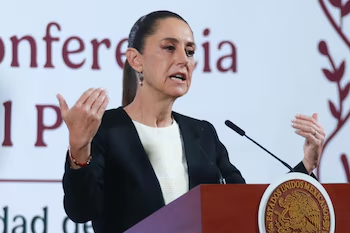
Claudia Sheinbaum Pardo, the current president of Mexico, recently made headlines during a morning press conference. In a firm tone, she stated that no one is exempt from the law, emphasizing that if a crime is committed, it must be addressed regardless of who the perpetrator may be.
The Context of the Declaration
This strong statement came in response to questions surrounding allegations made by Norma Otilia Hernandez, the former mayor of Chilpancingo. Hernandez, in her recently published book, claimed that a meeting she had with organized crime leaders was orchestrated by certain priests.
Sheinbaum’s Comments
In her remarks, Sheinbaum pointedly said, “If a crime is committed, even if you are a priest, police officer, or public servant, the law must be followed.” She indicated that if there was indeed a violation of law, it would need to be examined to determine if it warrants a formal complaint.
Despite not having read Hernandez’s book, Sheinbaum reiterated her core message: “No one is above the law.” She stressed that determining whether a crime has occurred is crucial, stating that not every interaction constitutes criminal behavior, and noted the responsibility of the appropriate authorities to investigate further.
Understanding the Allegations
The controversy surrounding Hernandez’s claims escalated when a video surfaced showing her and Celso Ortega Jiménez, a known leader of the criminal organization “The Ardillos,” dining together. This incident triggered wide discussions about potential collusion between public figures and organized crime.
The Role of the Clergy
In her book titled The Perfect Trap, Hernandez also mentioned the involvement of two clergy members from Guerrero during her meeting with Ortega. Local reports have identified at least one of them as Antonio Bravo Salgado, a priest in the Chilpancingo diocese.
The Broader Implications
Sheinbaum’s statements have highlighted a critical issue in Mexico—accountability for those in positions of power. The perception of clergy or public servants being above the law has long troubled the Mexican public. Sheinbaum’s call for equality before the law aims to restore trust in public institutions and ensure that justice prevails, irrespective of individual status.
Conclusion
As Mexico grapples with deep-seated issues of corruption and organized crime, addressing these allegations with a commitment to justice could signal a turning point. The president’s declaration asserts a determination to hold all individuals accountable, aiming to reinforce the notion that “no one is exempt from the law.” This principle may pave the way for a more transparent and just society.