
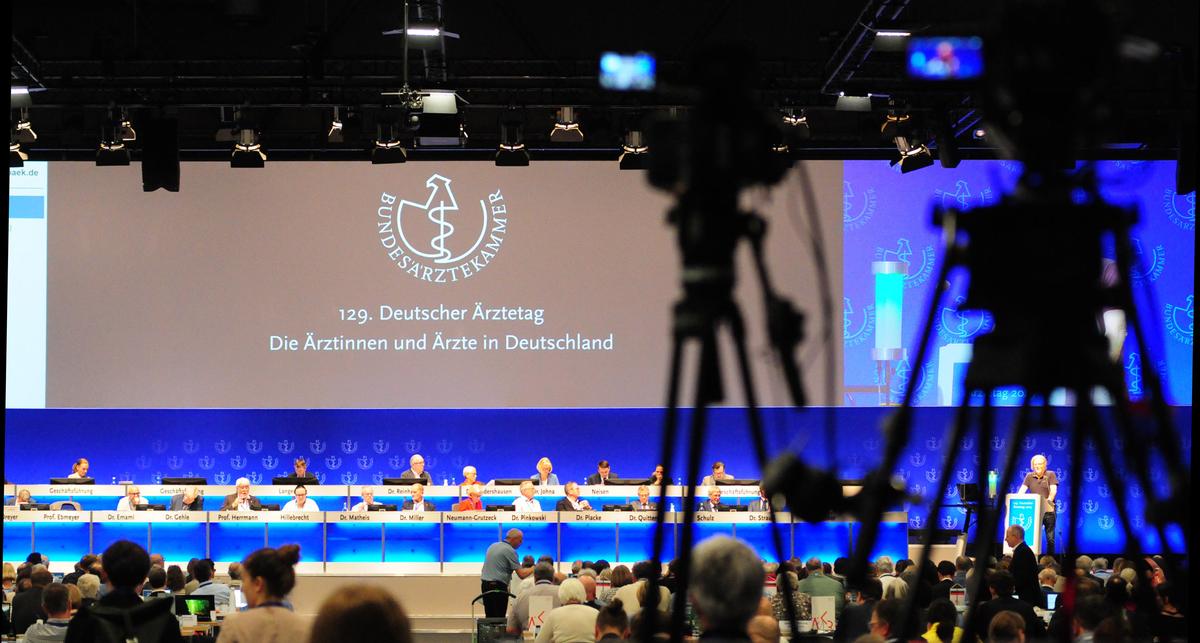
Leipzig – The new Fee Schedule for Physicians (GOÄ) has been officially approved. Delegates at the 129th German Medical Congress today voted overwhelmingly (212 in favor, 19 against) in support of the draft proposed by the Federal Medical Association (BÄK) , the Association of Private Health Insurance (PKV), and the civil service health care scheme (Beihilfe).
BÄK President Klaus Reinhardt previously warned that rejecting the GOÄ draft could jeopardize the political credibility of the medical profession. He remarked that continuing “the status quo” offers no certainty.
Given the years of effort involved, it cannot be said that this was a rushed decision. The process has also seen a great deal of transparency . Around 165 professional and specialist associations were extensively consulted, Reinhardt emphasized. During numerous clearing discussions, adjustments were made to the GOÄ draft.
It is crucial to recognize that the medical profession must establish a “reasonable balance of interests” with the PKV and the civil service health care scheme. There needs to be a balance between the legitimate interests of medical practitioners and those responsible for payments.
Reinhardt highlighted the improvements that the new GOÄ will bring. It offers a differentiated, clinically developed catalogue of services , greater legal certainty, transparency, and reinforces the dual system of both private (PKV) and statutory health insurance (GKV). Furthermore, if implemented politically, the new GOÄ would result in better compensation for a broad range of physicians without overwhelming patients with a projected 13.2% increase (approximately €1.9 billion ) in private health insurance expenditures within the first three years.
Clear Consensus Emerges in Debate
In a roughly one-hour debate featuring 25 speakers, diverse arguments were exchanged. The prevailing mood was clear: 21 representatives supported a new GOÄ while four opposed it.
Many voices lamented the external influence on the debate. Several reported that phone calls prior had often been irrelevant, with a flyer distributed at the Leipzig fair grounds stirring controversy. Günter Meyer from Lower Saxony denounced the anonymous flyers as a “low point in collegial dialogue,” asserting that “such disrespect for the democratic process of the German Medical Congress” must be firmly rejected.
“We must respond with a clear vote in favor of the GOÄ against these pressures from various sides,” stated Bernd Haubitz from Lower Saxony. Reinhard Reichelt from Bavaria echoed this sentiment, indicating his desire to “send a strong signal because politics is waiting.”
Oliver Funken from the North Rhine Medical Association further elaborated that previously there had only been “frustrating attempts” to reform the GOÄ. With the opportunity now “on the penalty spot,” he urged for completion – nothing more needed to be said.
Some speakers worried that failing to reach a decision might allow politics to take control and implement a GOÄ devoid of medical influence. Marlene Lessel from Bavaria emphasized the importance of demonstrating to both politics and society that the medical profession can make decisions collectively. “This message is extremely important.” Likewise, Jens Placke , President of the Mecklenburg-Vorpommern Medical Association, stressed the necessity of updating outdated regulations .
“We serve as the voice of the medical profession towards politics and the public, and therefore have to address this,” asserted Tilman Kaethner from Lower Saxony. He described the new GOÄ as a compromise, one he was not enthusiastic about but acknowledged nonetheless.
The proposed enhancement of conversation services in the new GOÄ was repeatedly praised. Nicola Buhlinger-Göpfarth , a general practitioner in Baden-Württemberg , noted that medical work is increasingly being measured while artificial intelligence (AI) and digitalization are becoming more significant. “Thus, the value placed on conversation is vital. Because AI cannot do that.”
For Barbara Römer from the Rhineland-Palatinate, medical consultations go beyond mere conversation; “Talking to patients involves so much more. Therefore, it is critical that this is better compensated.”
Many delegates also countered earlier claims that practices would incur significant losses under the new GOÄ. “If a practice is basing its business model on this, then something is wrong,” explained Sabine Olischläger from Hesse. Niels Vogel from North Rhine considers the new GOÄ to be a “shield against investors and their interests.”
Hendrik Schönborn from Schleswig-Holstein, who identifies as a “radiologist’s husband,” mentioned that there are “radiologists who communicate, and for them, the new GOÄ fits well.” He also warned against governmental structures if self-governance does not propose its own solutions.
Critics also participated in the discussion. Wieland Dietrich from North Rhine projected a 30% real wage loss due to the new GOÄ. He and other critics sought a motion that would indirectly initiate a restart of negotiations. Markus Haist from Baden-Württemberg noted that there are significant differences between the GOÄ versions from 2022 and 2024. Dirk Palukat from Hesse pointed out the absence of a “robust cost calculation.” His motion was ultimately delegated to the board.
Following nearly an hour of discussion, delegates called for the end of the debate via a motion. They argued that all points had already been raised. With 116 votes in favor , a large majority of delegates supported this suggestion, although approximately 30 speakers remained on the list.
The joint draft will now be presented to the new Federal Minister of Health, Nina Warken (CDU). Following this, the regulation must still be approved in the federal cabinet. The regulation provider can then implement the new GOÄ as a legal regulation with consent from the Bundesrat.