
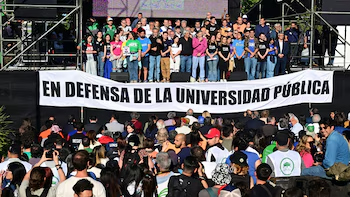
The National Inter-University Council (CIN), the Argentine University Federation (FUA), and the Syndical Front of National Universities have called for students, teachers, non-teachers, and researchers to mobilize on Tuesday, May 12, throughout the country for what will be the fourth Federal University March since Javier Milei took office. The main event will take place at Plaza de Mayo, with a gathering starting at 5 PM and speeches commencing at 6 PM.
Main Issues of the March
The main demands include non-compliance with the University Financing Law by the Casa Rosada, disobedience to court rulings that ordered immediate compliance with articles 5 and 6 of the law—referring to salary and scholarship adjustments—a decline in sector financing, and plummeting salaries, among other points.
Judicial Context
This mobilization comes at a moment of maximum judicial tension: last week, the Chamber III of the Federal Administrative Court allowed the Government to take the dispute over the University Financing Law directly to the Supreme Court, with suspensive effects on the order which obligated the State to transfer funds to the university system.
Historical Context of the Mobilizations
This event marks the fourth in a series of mobilizations that began on April 23, 2024, when over half a million people gathered on Avenida de Mayo and other points across the nation for the first mass protest against university disinvestment. The second was on October 2, 2024, in front of Congress, aimed at preventing the presidential veto of the financing law. The third took place on September 17, 2025, coinciding with the session that ratified the regulation with a supermajority in both chambers, with no modification in the government’s position across these three events.
The central demand has remained constant: to compel the Executive to adhere to the law sanctioned by Congress, which the Judiciary has upheld in two instances. Transfers to national universities have seen a real decline of 45.6% between 2023 and 2026, according to sector data. Additionally, teachers’ and non-teachers’ salaries have lost approximately 50% of their purchasing power, while scholarships for the Progresar program have remained frozen at $35,000 for two years—equivalent to December 2023 values—with 80% of professors earning below the poverty line.
Government’s Response and Educational Context
The government has claimed that the University Financing Law does not explicitly provide for funding sources and that its full application impacts “economic stability and the macroeconomy of the country.” The Subsecretary of University Policies is working on its project for a new law acknowledging a salary delay of around 12% for the 2023-2026 period, proposed to be paid in installments. The government has also pressured rectors to ensure classes continue and to suspend strikes.

Conclusion: Solidarity and Collective Action
As the mobilization prepares to take place across Argentina, it showcases a broad political and social spectrum, uniting the student movement, teacher and non-teacher unions, and several political parties. This action represents not only a defense of public education but also resonates with a widespread call for social justice, emphasizing the collective strength of communities in advocating for necessary systemic reforms.