
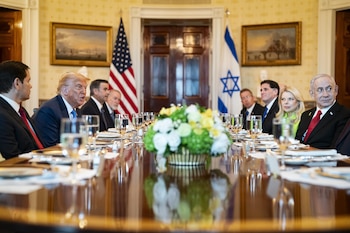
The prime minister of Israel, Benjamin Netanyahu , and the president of the United States, Donald Trump , have expressed optimism regarding a potential ceasefire agreement in the Gaza Strip . During a meeting at the White House , Netanyahu mentioned that both administrations are “close to finding several countries” willing to host Palestinians looking to leave the Gaza Strip. This announcement comes in the wake of a proposal made by the U.S. that has been rejected by Palestinian authorities and regional governments due to its perceived risk of ethnic cleansing .
During his remarks, Netanyahu underscored the notion of voluntary migration for Palestinians. He emphasized this sentiment by stating, “If people want to stay, they can stay; but if they want to leave, they should be able to do it.” Netanyahu criticized the current conditions in Gaza, suggesting that the Strip “should not be a prison but an open space.” This view aligns with his vision to facilitate what he termed voluntary migration .
In support of Netanyahu’s perspective, Trump added that there is “great cooperation” from neighboring countries to advance a plan for the Gaza Strip. “Something good will happen,” he expressed, reflecting an optimistic outlook regarding the situation.
Both leaders shared their thoughts amidst the ongoing negotiations in Doha, Qatar, aimed at achieving a permanent ceasefire in Gaza. Trump noted that Hamas seems eager to engage in dialogue, indicating a readiness to pursue an agreement.
When queried about the controversial two-state solution , Trump deferred to Netanyahu, who asserted that Palestinians must have the autonomy to govern themselves. However, he made it clear that “certain powers,” particularly those concerning security, will be retained by Israel. Netanyahu emphasized, “No one in Israel will accept something else, because we do not commit suicide,” referring specifically to the possibility of a state governed by Hamas .
Netanyahu’s comments come in light of Israel’s ongoing security concerns, particularly regarding Hamas’ history of violence against Israelis. He stated, “Look what they did with this state. They built it with bunkers and terror tunnels, massacring our people. … It is unlikely that people would agree to give them another state, as it would simply serve as a platform to destroy Israel.” He reinforced Israel’s determination to prevent another scenario similar to past conflicts, articulating that “we swore ‘never again’.” He stressed that history has taught them the significance of maintaining their sovereignty and security.
Despite these challenges, Netanyahu remains hopeful about establishing a lasting peace with “our Palestinian neighbors, those who do not want to destroy us.” He reiterated that control over security sovereignty must remain with Israel. He expressed a desire to create “a very wide peace that includes all our neighbors,” though he did not specify any particular countries interested in engaging in this peace process.
As the dialogue continues, the leaders are banking on U.S. involvement under Trump’s administration to foster a new era of cooperation in the region. The prime minister’s comments reflect a daunting yet hopeful outlook as Israel navigates complex relationships with its neighbors, and seeks stability while emphasizing its own security.
The potential for establishing a ceasefire and recalibrating relationships in the region pivots on the ability of both parties to commit to constructive dialogue, focusing on mutual security and respect. While the road ahead remains fraught with challenges, the showing of camaraderie between Netanyahu and Trump signals a calculated effort to redefine the future of the Gaza Strip and Israeli-Palestinian relations.