

AREA Research has released the results of an extensive survey conducted from May 20 to 24, involving 2,000 individuals across 26 provinces in Turkey. The survey employed the CATI (Computer-Assisted Telephone Interview) method to gather reliable data regarding voter preferences. With a margin of error of ± 2.19% , the findings provide significant insights into the current political landscape.
CHP LEADS AMONG UNDECIDED VOTERS
Participants were asked, “Which party would you vote for if a parliamentary election were held today?” Initially, before accounting for undecided voters, the Republican People’s Party (CHP) held 27% of voter intentions, whereas the Justice and Development Party (AKP) garnered 23.7% . Importantly, the percentage of undecided voters stood at 21% , indicating a substantial segment of the electorate that remains uncertain about their choices.
The voting intentions of other parties are as follows:
- Democracy and Progress Party (DEM): 6.4%
- Nationalist Movement Party (MHP): 5.8%
- Good Party (İYİ Parti): 5.7%
- Victory Party (Zafer Partisi): 3.4%
- Action Party (A Parti): 2.2%
- New Welfare Party (YRP): 2.1%
- Other parties: 2.7%
FOUR POINTS SEPARATE CHP AND AKP; MHP CLOSE TO THRESHOLD
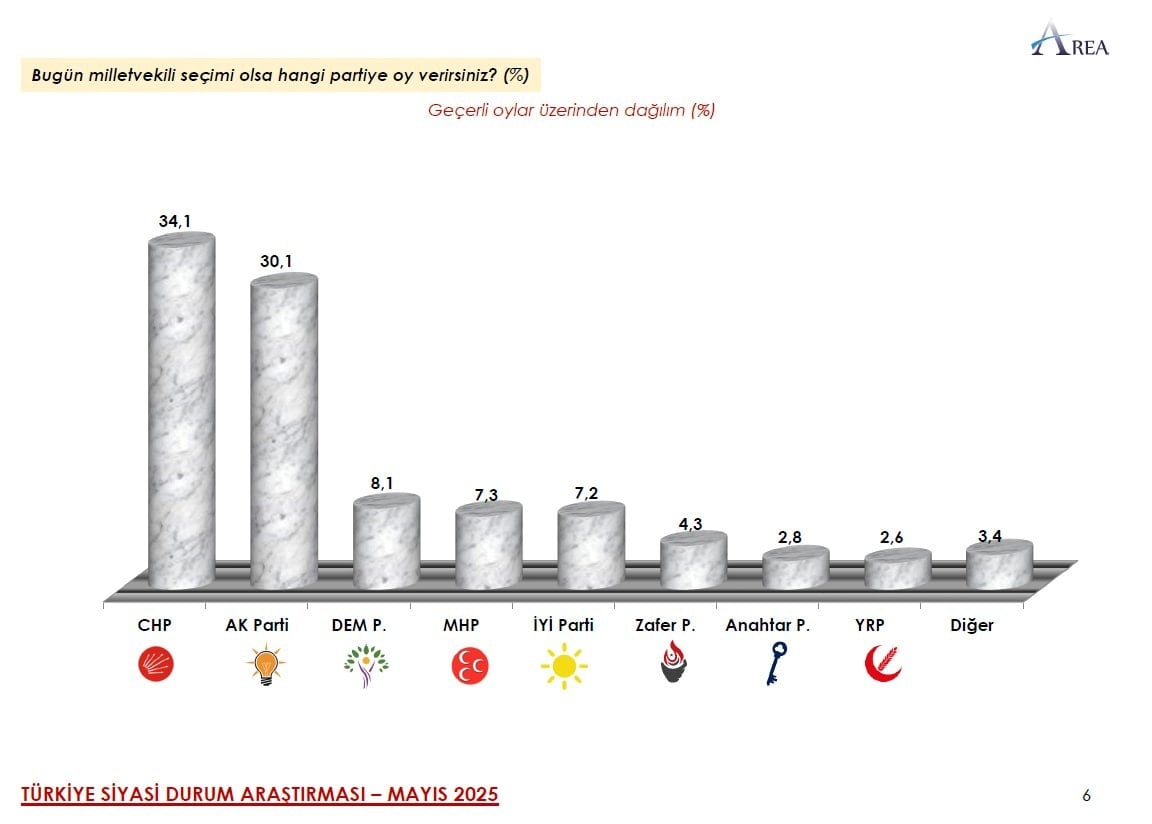
After distributing the undecided voters, the following results emerged:
- CHP: 34.1%
- AKP: 30.1%
- DEM: 8.1%
- MHP: 7.3%
- İYİ Parti: 7.2%
- Zafer Partisi: 4.3%
- A Parti: 2.8%
- YRP: 2.6%
- Other parties: 3.4%
The survey reveals that the CHP has managed to extend its lead to 4 percentage points over the AKP , marking a significant shift in political dynamics. Moreover, both the MHP and İYİ Parti appear to be approaching the electoral threshold, raising concerns about their viability in future elections. This indicates a potential shift in allegiances and highlights the evolving preferences of the Turkish electorate.
As the political environment continues to change, these results reflect the intense competition among parties and the crucial role of undecided voters. The political future, therefore, depends significantly on how these parties address voter concerns and reshape their strategies in the coming months.
In conclusion, as the landscape of Turkish politics becomes increasingly intricate, understanding the voter dynamics gleaned from surveys such as AREA’s will be essential for political parties in strategizing their campaigns effectively. How each party responds to the needs and sentiments of the electorate could determine their success in upcoming elections.
General News – 1