
BYD: Leading the Automotive Employment Revolution
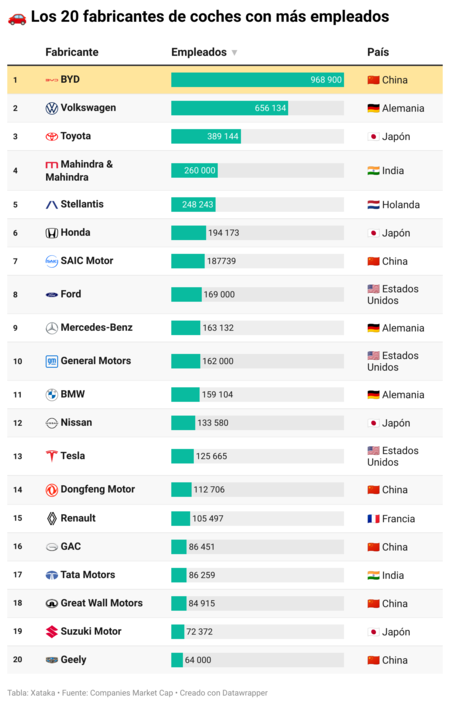
BYD, a Chinese behemoth in the automotive and technology sectors, has recently surpassed an astonishing 968,900 employees by the end of 2024. This figure surpasses the combined workforce of industry giants like Tesla, Toyota, Ford, BMW, and Renault. Although this number may seem excessive for traditional automotive manufacturers, it holds a clear rationale—BYD is not merely an automaker.
Methodological note: This employee count encapsulates the entire BYD Group, extending far beyond BYD Auto. In contrast to competitors who segregate their divisions, BYD embraces an integrated ecosystem where most employees are closely associated with automotive operations. Currently, the company has not published a detailed division-specific breakdown.
The Importance of BYD’s Workforce
The impressive employee count is indicative of a larger trend in the automotive landscape, particularly concerning vertical integration. BYD has constructed the largest vertically integrated ecosystem in the global automotive industry. Unlike Tesla, which sources batteries from Panasonic and chips from various suppliers, BYD prides itself on manufacturing nearly every component in-house.
This comprehensive approach spans four crucial industrial sectors:
Automotive Division: While this is the most visible segment, BYD also plays a pivotal role in supplying electronics for Apple.
Battery Manufacturing: The company ranks as the second-largest battery manufacturer worldwide.
Component Development: BYD engages in producing everything from semiconductors to heat pumps.
Apple’s Supply Chain: Over 110,000 employees are exclusively dedicated to assembling about 30% of Apple’s iPhones and iPads.
Understanding Employee Counts Among Competitors
It’s essential to note that BYD’s employee figure includes its entire range of operations, unlike competitors who feature varying structures. For instance:
- Volkswagen has 656,134 employees, but this number exclusively includes its automotive group, excluding significant sectors like finance.
- Toyota’s count of 389,144 employees pertains solely to Toyota Motor Corporation, not internal divisions like Aisin, Denso, or Boshoku, which would raise the overall figure closer to 800,000.
This information highlights the differing methodologies behind employee counts, enhancing the context within which BYD operates.
Vertical Integration: A Complete Manufacturing Ecosystem
BYD’s strategy revolves around an exhaustive model of vertical integration, with responsibilities encompassing:
Internal Production: Innovative components such as batteries, semiconductors, electric motors, and fast-charging solutions.
Quality Control and Cost Efficiency: This strategy facilitates superior quality oversight, reduced costs, and rapid innovation—an edge over competitors relying on external suppliers.
BYD’s factories in China employ tens of thousands of workers, with notable plants like the Zhengzhou facility housing around 60,000 employees and expected to employ 20,000 more.
Moreover, BYD is creating what are termed “industrial cities”—integrated environments providing housing, commercial establishments, and recreational facilities for employees.
Remarkable Growth and Future Outlook
BYD’s remarkable growth trajectory is supported by impressive figures:
- An employee growth rate of 37.73% in 2024, translating to over 265,400 new hires.
- A Research and Development team comprising 110,000 engineers, the largest in the automotive sector.
- A milestone of selling 4.27 million vehicles by the end of 2024.
The contrast with competing firms reveals striking differences:
- Tesla has laid off 15,000 employees.
- Ford plans to slash 4,000 jobs in Europe.
- Renault is contemplating a reduction of 3,000 jobs.
In stark contrast, BYD’s workforce continues to expand.
Since the past two years, BYD has hired almost 50,000 recent college graduates in China alone. The company is also implementing aggressive growth strategies internationally, with plans to establish factories in Hungary (providing 2,000 jobs ), Mexico (aiming for 10,000 positions ), as well as in Brazil , Thailand , and Indonesia . The aim is to ensure local talent is integrated into the production chain.
The sustainability of BYD’s employment-focused model in the face of increasing automation remains an open question. Although Tesla is leading the charge toward robotization, BYD appears to prioritize human labor as it explores a fully controlled production ecosystem.
BYD’s growth story is not just about numbers; it reflects a transformative approach to the automotive industry. As BYD continues to innovate and expand, its commitment to vertical integration and substantial workforce investments may redefine what we consider possible in the automotive sector—both now and in the future.