
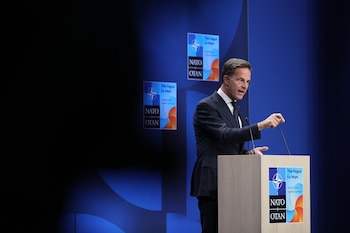
On Wednesday, NATO leaders convene in The Hague for a crucial summit centered on an urgent topic: the defense spending pathway for the next decade. The expectation is that all member countries will commit to a new spending threshold of 5% of GDP , as advocated by the President of the United States, Donald Trump . This new benchmark has faced pushback from Spain’s Prime Minister, Pedro Sánchez , who argues for fulfilling NATO’s military requirements without adhering to a strict percentage.
At this summit, NATO’s Secretary-General Mark Rutte has proposed a plan aiming for 3.5% dedicated to direct defense spending, alongside an additional 1.5% for security-related investments, reaching the 5% target that Trump has been pushing for months. Rutte described this approach as “an ambitious, historic, and fundamental leap” for the future security of NATO.
Despite some allies expressing concerns, including Italy , Canada , Slovakia , and Belgium , which have indicated challenges with the spending target, Spain has become the foremost opponent to this new goal. Rutte has suggested providing Spain with the flexibility to set its spending trajectory, reflecting its own capacity goals, in exchange for backing the summit’s declaration.
Spain views this concession as an exception to the general 5% objective, believing that it can only afford to allocate 2.1% to defense to meet its military commitments. Both NATO and various member states emphasized in recent hours that there are no possible escape clauses regarding the spending commitment for the 32 allies , and Rutte has warned Spain that it must increase its investment to 3.5% to align with NATO standards.
In a private communication revealed by Trump, Rutte has already anticipated an agreement within NATO to establish the 5% mark as the new spending target. This message was framed as a “victory” for Trump, illustrating Rutte’s intent to keep Washington engaged with NATO while avoiding conflicts with European allies. Trump’s comments, stating “Europe will pay heavily, as they should, and this will be your victory,” highlight the underlying tensions among the NATO allies.
Sources have indicated that the summit’s declaration will require consensus approval from all 32 members and that Rutte’s letter is intended as part of “internal consumption” for Sánchez. They assert that it does not formalize any exceptions for Spain nor recognizes a separate spending threshold.
SPAIN’S MILITARY SPENDING DISPUTE
On Sunday, NATO reached a preliminary agreement for allies to commit to increasing their defense spending to 5% by 2035 , a pact that needs ratification from the leaders. Spain has been urging the adoption of Rutte’s letter and altering the language of the declaration to allow for “constructive ambiguity,” which could facilitate a more flexible approach to the spending threshold, refraining from definitively stating that all members will adhere to the 5% target.
In the midst of this debate, Trump publicly chastised Spain while aboard Air Force One , labeling it a “problem” within NATO due to its inadequate defense spending. He asserted, “Spain does not agree; this is very unfair to the rest.” The criticisms included a graphic he shared on his social media, illustrating the defense spending levels within NATO, contrasting Trump and Rutte against Sánchez, highlighting that Spain is currently the lowest spender in the alliance.
The headline from Graphic News captured the essence of the dilemma: “Spain threatens to derail NATO summit.” This situation raises concerns over whether the allies can maintain unity and reach an agreement on such a divisive issue, underscoring the continual challenges facing NATO’s cohesion amid diverging national interests.
In summary, the NATO summit in The Hague is poised to be a pivotal moment for the alliance as it grapples with significant tensions regarding defense spending. The outcome will not only affect Spain but has broader implications for NATO’s future unity and effectiveness. As member states navigate these complex discussions, the decisions made here could shape the alliance’s defense strategies for years to come.
General News – 2