
In a very distant planetary system, approximately 1,113 light-years from Earth, logic would lead us to believe that if a planet approaches the size of Jupiter, it should also resemble it in mass. However, NASA’s TESS mission has revealed that the universe often defies such straightforward expectations. Recent data has unveiled two giant worlds orbiting the star TOI-791 that challenge this notion: while they occupy significant space, they possess surprisingly little matter.
These celestial bodies are dubbed TOI-791 b and TOI-791 c, categorized as “super-puff” planets. This term refers to their extremely low densities, which are intriguingly comparable to that of cotton candy. Researchers assert that these two planets represent the most “bloated” ones ever found, boasting sizes comparable to Jupiter, yet their masses are a mere fraction of that of the largest planet in our solar system.
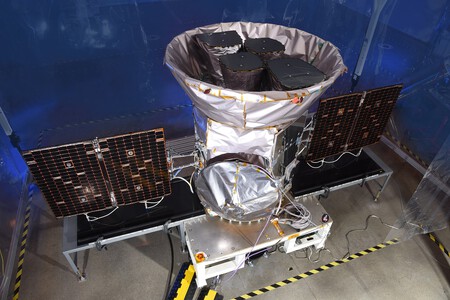
The spotlight in this discovery is on NASA’s TESS (Transiting Exoplanet Survey Satellite). Unlike a telescope designed to capture direct images, TESS operates as a space observatory tailored to monitor vast areas of sky, focusing on indirect signals. Its primary instrument consists of four wide-field optical cameras, which collectively track stars for extended periods.
Two Giant Planets That Weigh Almost Nothing
Crucially, TESS did not capture images of these planets like we might see of Jupiter or Saturn. Instead, it detected minute decreases in brightness from the host star, TOI-791. This light dimming occurs as a planet orbits in front of its star, obscuring a tiny fraction of light. By analyzing these transit patterns over time, scientists can deduce the existence of worlds that are too far to be pictured conventionally.
This situation often creates a deceptive impression. Many might envision the NASA illustrations as actual photographs, but the truth is that no direct images of TOI-791 b or TOI-791 c have been captured. The visuals are artistic interpretations intended to help us conceptualize the discovery and compare it with known planets; the real observations are rooted in the signals measured during the transits.
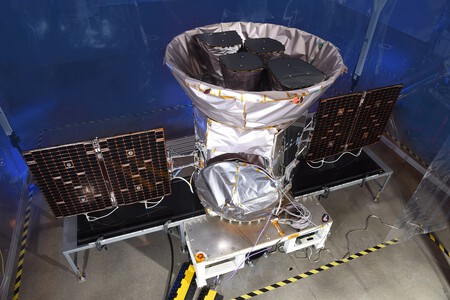
The TESS spacecraft and its payload, prepared before launch
The extraordinary nature of these findings becomes increasingly evident when examining the figures. TOI-791 b is nearly the same size as Jupiter but has only 3.0% of its mass, while TOI-791 c exceeds Jupiter’s size and barely reaches 5.9% of its mass. This peculiar combination renders them remarkably unusual — not small planets with minimal mass, but rather gigantic bodies that occupy considerable volume with strikingly low mass density.
Patience plays a vital role in this investigation. TOI-791 b orbits its star in 139 days, while TOI-791 c takes 232 days to complete a similar journey. For TESS, this lengthy process requires a significant amount of further observations to confirm the transit and exclude coincidences. Over seven years, TESS collected 1,122 days of observations of the TOI-791 system, which proved critical for establishing reliable data.
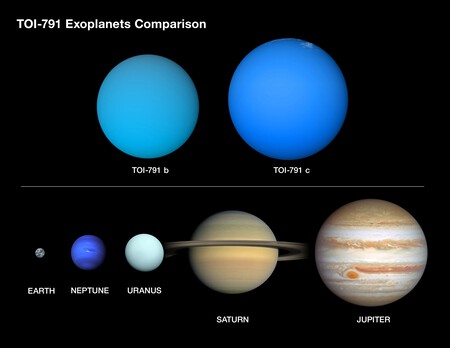
The image compares the size of the two “super-puff” planets with some worlds in our Solar System
To determine their masses, scientists utilized a key detail: TOI-791 b and TOI-791 c have gravitational interactions that influence their orbital motion. The mutual attraction causes them to slightly alter the timing of their transits across the star, allowing researchers to calculate the mass of each planet while confirming their classification as low-density “super-puff” planets.
This discovery raises perplexing questions. These massive worlds with such low mass contradict previous models of planetary formation and evolution. NASA Ames’ Jon Jenkins noted, “They represent a puzzle.” George Dransfield from the University of Oxford also noted how their extraordinary low densities render them fascinating subjects for further investigations about planetary system evolution, marking their discovery as the starting point of a deeper inquiry.
Going forward, the aim is to investigate these super-puff planets in greater detail. NASA scientists plan to analyze their atmospheric chemical composition, assess how their rotation may shape them, and determine how the star’s inclination corresponds with the planets’ orbits. There is also a need to explore how these planets evolved within the system, including their interactions with other celestial bodies and ultimately how such uniquely low-density worlds can be formed. While the term cotton candy serves as a delightful metaphor, the scientific challenge is to decode the recipe behind their existence.
Images | POT
In Xataka | Experts warn: NASA launch facilities are too old to travel to the Moon