
The Mysterious Disappearance of Lac Rouge
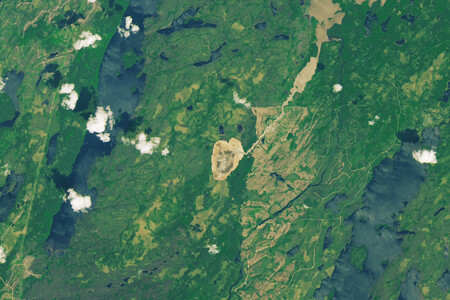
In the spring of 2025, a shocking event unfolded in central Quebec: Lac Rouge, a 1.4 square kilometer lake nestled in the Lac-Walker region of Sept-Rivières, vanished in just 15 days. This once-thriving body of water, vital to the Waswanipi Cree First Nation for hunting and fishing, faced an abrupt and unusual disappearance, captured by NASA’s Landsat 9 satellite. This phenomenon has raised numerous questions about the underlying causes and its broader implications.
What Happened to Lac Rouge?
The disappearance of Lac Rouge was signaled by the destruction of an access road, reported by local inhabitants. On April 29, 2025, the lake was still filled with water, yet by May 14, it was completely dry. The local administration issued a statement, alerting the community to the sudden change. However, the lake didn’t simply evaporate; it relocated its water. Instead of following the usual outlet channel, the water carved a new route northeast, traversing a 10-kilometer chain of lakes and wetlands until reaching Lac Doda. This remarkable transformation left behind light brown sediment deposits visible in satellite imagery.
The Science Behind the Disappearance
Researchers identified this phenomenon as an outburst flood, a type of flash overflow flood where a section of the shoreline collapses, allowing water to escape rapidly through a new channel. NASA Earth Observatory confirmed that the east bank of Lac Rouge had given way, triggering the rapid drainage. While this flooding mechanism is common in glacial lakes with unstable barriers, it is atypical for Lac Rouge, which is bordered by soft sedimentary soil.
Basin hydrology principles explain how reduced vegetation cover allows water to saturate the soil, weakening the banks. Hydrologist Younes Alila from the University of British Columbia notes that disturbances such as forest fires and logging can raise the water table, exacerbating the risks of flooding.
Broader Implications of Lac Rouge’s Disappearance
Lac Rouge’s sudden disappearance serves as a warning sign about the escalating effects of climate change, which is increasing the frequency of wildfires and destabilizing ecosystems. According to the Intergovernmental Panel on Climate Change (IPCC), the combination of heightened logging activities and frequent fires leads to a precarious state for bodies of water situated in soft geological areas.
This crisis disproportionately affects indigenous communities that rely on the boreal forest for their survival. Over 600 communities depend on this ecosystem, and events like the disappearance of Lac Rouge threaten not only their livelihoods but also the delicate balance of local ecosystems.
Factors Contributing to the Event
A closer examination reveals multiple factors contributing to the disaster:
Forest Fires
Lac Rouge had experienced significant wildfire activity in 2019 and 2023, with the latter marking Quebec’s most severe fire season in over a century, burning 4.5 million hectares. These fires devastated mature vegetation in the basin, weakening the shoreline that ultimately gave way.
Intensive Logging
Post-fire, logging companies exacerbated the problem by scarifying the land, compromising soil integrity and increasing hydrological degradation in the area. This disruption made the landscape even more susceptible to flooding.
Rapid Thawing
The winter preceding the incident brought an atypical snow accumulation, followed by a rapid thaw in 2025. This sudden influx of water overwhelmed the weakened shores, leading to the catastrophic event.
Natural or Human-Caused?
The Quebec government attributed the lake’s disappearance to natural causes and deemed further investigation unnecessary. They argue that if less than half of a watershed’s forest is damaged, the risk to nearby water bodies remains minimal. However, international experts and the Cree community challenge this perspective, emphasizing that cumulative damage and the accelerating effects of climate change require re-evaluation of risk assessments.
Conclusion: A Call to Action
The collapse of Lac Rouge signals a crucial turning point for environmental management in the region. It highlights the urgent need for a reassessment of forestry practices and a collective effort to address climate change. Without serious intervention, events like the disappearance of Lac Rouge may become more frequent, posing severe risks not just to indigenous communities but to entire ecosystems reliant on stable water bodies. The time to act is now.