
In recent weeks, I have been using the Aura Triple Aero 15.6 ”Pro Max, an intriguing device featuring three external monitors that fold into one piece. This compact workstation promises to transform any space into a productive environment with a total screen real estate of 43 inches. After testing it both at home and in a hotel, I have gained insights into who might benefit from this €520 product.
The first time I set up the three screens at home, the immediate satisfaction of having ample visual space was undeniable. While the setup process isn’t entirely intuitive, it becomes swift—taking about thirty seconds from unpacking to being fully operational.
With a single USB-C cable connecting to my laptop—providing both image and power—along with an additional power supply, the three screens came to life. Its elegance lies in this simplicity.
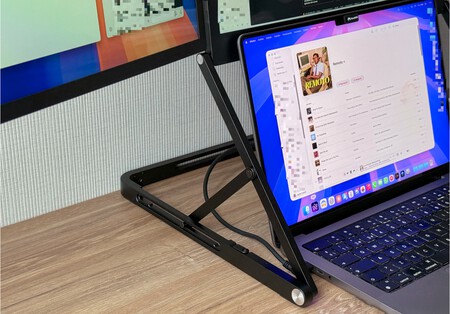
<span>Image: Xataka.</span>However, there’s a subtle caveat: the device weighs 3.2 kilos. Though not overly heavy, this weight becomes significant when lugging around additional luggage. Moreover, its dimensions necessitate a larger backpack; my usual one wasn’t big enough to accommodate it. The 15.6-inch screens provide a satisfying viewing experience, but the surrounding metal structure adds to its bulkiness.
Reorganizing my cabin suitcase was essential, as the device barely fit inside. One more centimeter in thickness, and I would have needed a larger suitcase—one not suitable for cabin use.
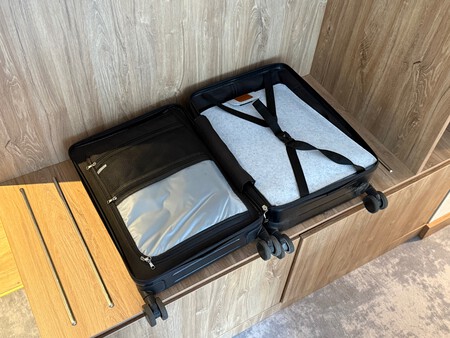
<span>If it became a few centimeters larger, I wouldn’t have been able to carry it in the cabin. But it fit. Image: Xataka.</span>Next, let’s discuss the reality of Full HD in the year 2025. I have been accustomed to a 4K monitor at home and to a 14-inch portable screen. The difference in sharpness is palpable.
- MacBook Pro 14 “: 3,024 × 1,964 pixels. Density: 254 ppi.
- Huawei Mateview 28,2 “: 3840 x 2560 pixels. Density: 163 ppi.
- Aura Triple Aero 15.6 “Pro Max: 1920 x 1080 pixels (each panel). Density: 141 ppi.
Not only is the sharpness lacking, but the panel quality also lags behind. With an IPS/WLED panel, a maximum brightness of 350 nits, and a contrast ratio of 1,200:1, the three 1080p screens of the Aura are definitely functional. However, transitioning from a modern panel’s pixel density makes the text clarity suffer.
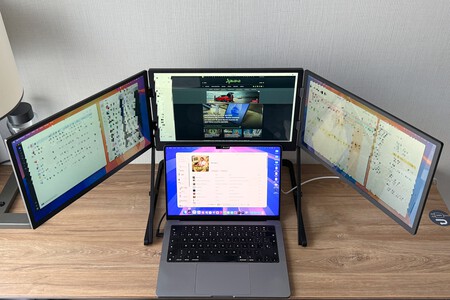
<span>Image: Xataka.</span>While using these panels, I once struggled to differentiate a point from a tilde in an email. It was merely a dot. This is the concession one might accept in a travel device, yet it prevents the Aura from serving as a permanent replacement for my desktop setup. Although this may not be the product’s intent, it’s worth considering.
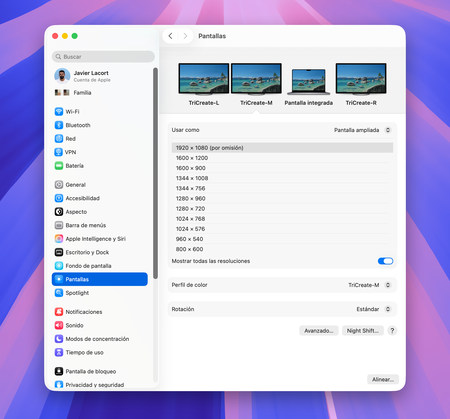
<span>Accepted resolutions. Image: Xataka.</span>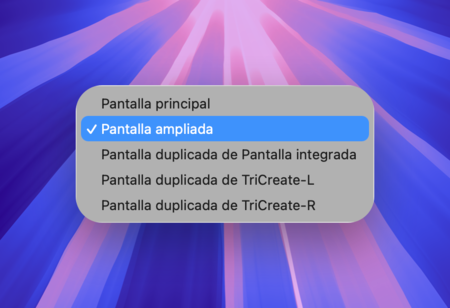
<span>Screen arrangements or duplications. Image: Xataka.</span>During my hotel stay, the device faced its true test. I had to prepare interviews and analyze specific business data. In this context, the Aura excelled.
Being able to review spreadsheets while keeping documents open on one panel and streaming Apple Music on another made my work seem worthwhile. The real productivity began at home, where I finalised details for the hotel. However, the logistics of setting up, packing, and transporting the system during my entire trip made me ponder whether the additional space and weight were justified.
A noteworthy feature I did not initially consider is the ability to configure the screens in various orientations. You can layout them straight, tilt the sides towards you like a cockpit, or surprisingly, arrange them in a triangular formation due to their magnetized edges, ensuring a stable setup.
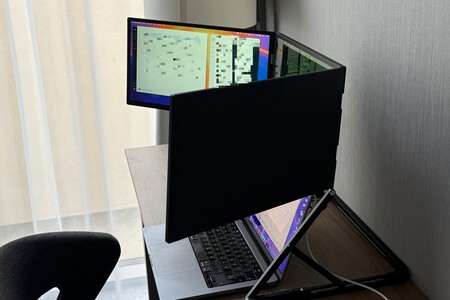
<span>Enhance the experience by tilting the side screens towards you... Image: Xataka.</span>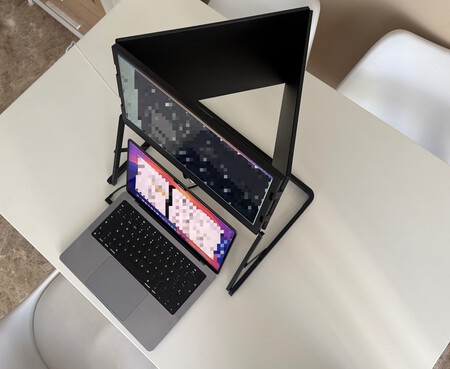
<span>... or arrange them in a triangular form for wider visibility without crowding around the main screen. Image: Xataka.</span>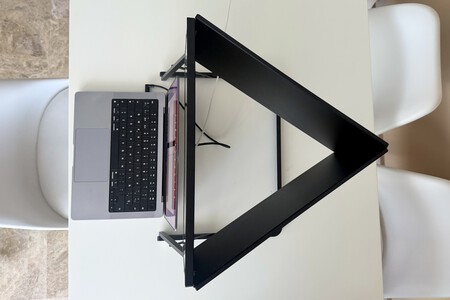
<span>Bird's-eye view of the triangular layout. Image: Xataka.</span>This feature serves a specific use case: allowing multiple people to view the screen without crowding around a single monitor at a table. While incredibly useful for that scenario, it’s still a niche requirement.
The system includes an integrated speaker directed towards the back of the central panel. It’s functional, but don’t expect exceptional sound quality; the built-in speakers of my laptop perform better.
The stand is sturdy and offers three height options, although the lowest height feels slightly unstable under the weight of the setup. Care should be taken when handling this frame; additionally, the product box includes tempered glass protectors for the three panels as well as a transport case.
<span>Image: Xataka.</span>All accessories are sold separately, but I would assert that a case is almost imperative for Aura users. Without it, the exposed screens can easily get damaged when the device is folded.
This product is not entirely plug and play: Drivers need to be downloaded from the manufacturer’s website. However, once installed, usability is immediate.
<img alt="I've been using a 5K monitor for years. I still do not understand how the industry has not made them massive" width="375" height="142" src="https://i.blogs.es/398d9a/dell-1/375_142.jpeg"/>The central question about the Aura revolves around its target audience. It’s a unique product that piques interest when seen in passing on a tweet or an advertisement. After a few weeks of use alternating between home and hotel, I have pinpointed the ideal user: someone who travels frequently for work and needs extensive hours in hotel rooms. For professionals who constantly move between airports and require a multi-monitor setup that fits into a suitcase, the investment of 520 euros and the extra 3.2 kilos may be justified.
For the average user—myself included, who travels occasionally and doesn’t spend long hours working in hotels—it may be an overindulgence. At home, I can obtain superior image quality for half the price with a 4K monitor. For short trips, the added weight and volume aren’t compensated by the productivity gained.
The Aura Triple Aero Pro Max is a product that fulfills its promise: three portable screens that you can easily carry. The aluminum build is sturdy, and its ingenious folding mechanism enhances the user experience when utilized optimally.
Nonetheless, it targets a very specific market. If you don’t travel at least twice a month and work long days from hotels, you might be investing in an expensive luxury that won’t be put to good use, especially when compared to more affordable desktop alternatives.
It’s a classic case of specialized products—the ideal choice for those who truly need it and a costly whim for most others. However, who am I to judge the desires of others?
Image credit: Xataka
In Xataka | How to calibrate your computer monitor: essential steps and tools.
This device was provided for testing by Aura. You can learn more about our review process in Xataka.
Read our ethical policies regarding product testing.