
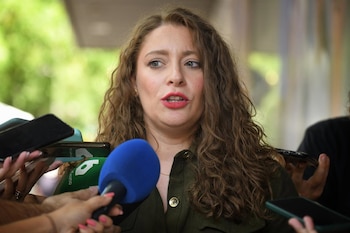
The Deputy Secretary of Health and Education of the PP and future parliamentary spokesman of the Popular Group in Congress, Ester Muñoz , has criticized the second vice president , Yolanda Díaz , for her daily expressions of anger regarding alleged corruption cases involving the PSOE . Despite her criticisms, Muñoz points out that Díaz has not taken any substantive action to resign from the government or to abandon Prime Minister Pedro Sánchez . Muñoz stated, “*If this is a borderline situation, what she should do is leave the government and drop Pedro Sánchez or at least demand a matter of trust. Why don’t they present the issue of trust? Because Mr. Sánchez probably does not pass it,*” highlighting the lack of accountability.
Díaz has recently intensified pressure on Sánchez, demanding that he move away from what she calls “immobility” and start signaling a commitment to democratic regeneration and social progress. Her announcement comes ahead of a significant meeting of the PSOE’s Federal Committee, where she has made it clear that the current legislative session needs decisive action. She insists it “*cannot go on*,” implying that the government must change its approach.
Muñoz also pointed out the serious allegations surrounding corruption within the PSOE, emphasizing Sánchez’s reluctance to call for elections due to his awareness that he would likely lose them. She referred to the imprisonment of Santos Cerdán , a high-ranking member of the PSOE, remarking that he was “*the architect of this legislature*,” primarily through his pacts with figures such as Arnaldo Otegi from Bildu and Carles Puigdemont from Junts .
Declining to support a motion of censure against Sánchez, Muñoz stated that the Popular Party (PP) does not wish to offer “*an oxygen ball*” to the current administration. Instead, she shifted focus to Sánchez’s coalition partners, stating, “*He announces that Díaz is even angrier than the day before, but does absolutely nothing.*” This criticism extends to the lack of assurance from Díaz regarding the absence of “irregular financing” within the PSOE.
Furthermore, Muñoz emphasized that the responsibility for action lies within the government, particularly with Díaz, who remains part of a corrupt system but does little other than express her frustration. She called this behavior “*completely incomprehensible.*”
In light of internal party dynamics, Aitor Esteban , the president of the PNV , likened the PP to “*Dr. Jekyll and Mr. Hyde*,” due to their contradictory approach to dialogue. In retaliation, Muñoz did not acknowledge any insults directed at the PNV and mentioned evolving concerns regarding certain business relationships tied to the alleged corruption in the so-called “*Cerdán Case*.” Muñoz remarked that journalistic and even judicial reports have suggested possible connections between these corrupt networks and the PNV but emphasized that such issues do not involve the Popular Party .
The PP aims to maintain a clear stance: they want all parties to take an unequivocal stand against corruption. Muñoz stated that parties must either align themselves against corruption or risk becoming complicit. She expressed that, beneath Esteban’s political maneuvering lies a fear of losing political power within the Basque Country, saying, “*Between losing power and being honest, they will know what they want to do.*”
Muñoz concluded by reiterating her party’s commitment to constitutional governance. In reference to Junts , she urged them to evaluate whether they want to support a “*liar*” like Sánchez or associate with those genuinely seeking progress for citizens, including Catalans. This week’s approval of a PP-supported proposition to lower taxes was cited as evidence of cooperation on significant legislative goals.
Nonetheless, Muñoz affirmed the PP’s position against the Amnesty Law , pending the Court of Justice of the European Union’s ruling, maintaining that the law remains “*illegal and unconstitutional.*” She summarized her and Miguel Tellado’s approach within the PP, distancing herself from labels of hardness or moderation. Rather, she characterized their stance as “*clear,*” underscoring the necessity of presenting a realistic alternative to the Socialist Party that the Spanish people are anticipating.
As political tensions rise in Spain, the underlying issue remains—how effectively will the government address corruption and restore public trust? The PP , under the assertive leadership of figures like Ester Muñoz , believes that only a credible alternative can pave the way for a healthier democratic landscape in Spain.