
The Digital Persona of Donald Trump: Navigating Power and Perception
In today’s digital age, the political narrative not only serves as a reflection of power but fundamentally shapes it. Figures like Donald Trump leverage this environment where image, words, and gestures combine to construct a definitive identity, one that heavily influences public perception.
The New Political Landscape
As political narratives evolve, they begin to resemble performance art, designed to project strength and authority. Leaders today are not just politicians; they are digital personas, meticulously crafted to resonate with their audience. Trump epitomizes this with his bold declarations and flamboyant self-portrayal. Recently, he proclaimed himself the “Acting President of Venezuela” via his social media platform, Truth Social, signaling a strategic assertion of influence that prioritizes narrative over formal institutional recognition.
Truth vs. Perception
In this age of information overload, the lines separating fact from fiction blur remarkably. Trump’s self-application of a political title without any grounded legitimacy showcases a larger trend: credibility is now about what is emotionally resonant rather than what is empirically true. Indeed, power frequently rests upon the power of suggestion rather than factual validation.
Character Dynamics: Delcy and María Corina
In the context of international relations, Trump’s recent engagements with Venezuelan figures illustrate his complex political maneuvering. The juxtaposition of his relationships with Delcy Rodríguez and María Corina Machado highlights his strategic inclination. While he praises Rodríguez, the interim president aligned with the Maduro regime, he remains cold towards Machado, the esteemed leader of the Venezuelan opposition. This duality showcases Trump’s requirement for two different narratives to solidify his political stance: one that appeases the established regime and another that aligns with opposition aspirations.
The Influence of Delcy Rodríguez
Rodríguez embodies a paradox, balancing a legitimacy rooted in socialist ideology while simultaneously appropriating Trump’s populism. Her cooperation with Trump reflects a vital synergy that empowers both parties. As she navigates the complexities of Venezuelan politics, her alignment with Trump allows for symbolic leverage, further strengthening his narrative.
María Corina Machado’s Role
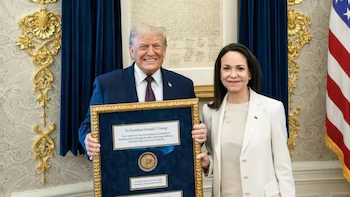
On the other hand, Machado’s symbolic gesture of presenting Trump with a Nobel Peace Prize serves to elevate her status while simultaneously reinforcing the narrative of a unified front against socialism. Her trust in Trump signals her hope for a liberated Venezuela. However, the absence of a clear, structured dialogue during their meeting underscores the transactional nature of political relationships in the current landscape.
A Blurred Reality
Political communication today thrives on ambiguity and the capability to project ideals that may not necessarily align with reality. Such strategies harvest attention and foster a supportive echo chamber, allowing leaders to mold international perceptions dynamically. The ambiguity enables leaders to remain relevant, even when facts contradict their narratives. In a world shaped by digital identities, these crafted personas become platforms of power.
Conclusion: The Future of Political Identity
As the age of strategic hallucination continues, political figures like Trump illustrate how perceptions are constructed and manipulated. His relationships—be it with Delcy Rodríguez or María Corina Machado—reflect this intricate dance of political strategy. Through these connections, narrative overshadows reality, sowing seeds of influence across the globe. As politics entwines more deeply with digital identities, the future will likely see further blurring of these boundaries, redefining how power is visualized and contested in the international arena.