

There was a wonderful time when you bought an iPhone, and Apple not only included the cable and charger but also the EarPods headphones. In 2020, the iPhone 12 arrived and broke that tradition: that box included the phone and the charging cable, but nothing else.
All manufacturers followed suit with the same Apple speech: at that point, users were told by various other brands that this action was aimed at protecting the environment, even if that argument was not particularly convincing.
Of course, they did something else: first they saved money by not including those elements, and then they earned it when you purchased official headphones and adapters if you ended up needing them. While one could turn to third-party accessories, Lumafield tomography scans have long shown that cables, chargers, and headphones from brands like Apple are costly because they are small works of art of engineering. In fact, these scans also revealed that trusting “strange” cables can lead to potential risks, including security threats.
The truth is that Apple’s decision—mirrored by companies such as Fairphone—has had profound effects on the industry. Today, it is rare to find a mobile phone that comes with a charger, much less headphones.
But things are set to go further. It appears that USB charging cables may also be on the verge of disappearing from product boxes.
Do We Really Need the USB Cable Included With Our Devices?
A Reddit user recently revealed their experience of buying a Sony Xperia 10 VII, where they discovered that the box contained no charger and—surprisingly—no charging cable either. As photographed, this absence was prominently displayed on the back of the box.
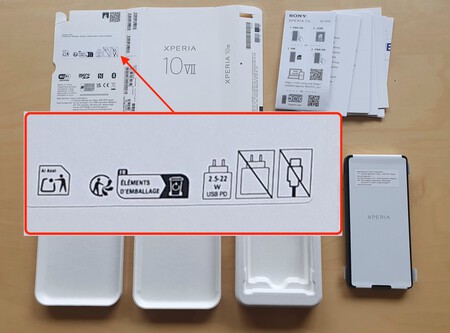
The Sony Xperia 10 VII does not include a charger or charging cable.
While Sony may no longer be a major player in the mobile market, these types of decisions can set a significant precedent for other manufacturers. We contacted Sony representatives to uncover their reasoning behind this choice. Although we await confirmation, it seems plausible that environmental protection and reducing electronic waste remain crucial factors, even if potential savings for Sony also play a role.
The European Union has been striving to mitigate electronic waste for years. They established the USB-C connector as the standard for charging mobile devices, which has, for example, pushed Apple to phase out its Lightning connector.
Over the years, users have collectively built up an impressive collection of USB-C cables to charge their devices. This situation mimics that of chargers: typically, most people already have one at home, so the necessity of including them in the box is increasingly questioned.
Nevertheless, mobile phones evolve to support faster charging and data transfer speeds. Such advancements mean that specialized cables and chargers can be required to exploit these enhanced capabilities fully.
Even in those scenarios, the necessity of including a charger or cable seems negligible. Manufacturers primarily offer “basic” models that do not allow maximum usage of the device’s capabilities. Historically, these items are offered individually, creating an extra financial burden for consumers.

Will we therefore witness a decline in the number of USB cables included in mobile phone boxes? This seems likely. Now, it remains crucial for manufacturers of USB-C cables to address an ongoing challenge: labeling their products effectively so users can determine which cable is appropriate for their needs at any point in time.
Image | Zana Latif
In Xataka | The USB-C standard promised to solve the connector chaos. The situation is worse than ever.