
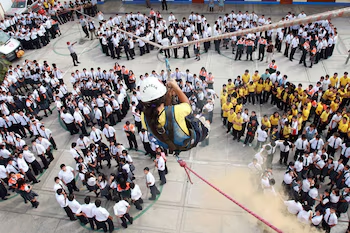
Over 9 Million Schoolchildren Prepare for First National Multihazard Drill 2026
On May 29, 2026, a staggering 9 million schoolchildren and 613 thousand teachers from 87 thousand educational institutions across Peru will participate in the First National Multihazard Drill. This significant initiative, coordinated by the National Institute of Civil Defense (Indeci) and the Ministry of Education (Minedu), aims to enhance the preparedness of the school community against various natural threats.
Understanding the Drill
The exercise will occur in three shifts: 10 AM, 3 PM, and 8 PM. It is designed to strengthen the community’s readiness for emergencies such as earthquakes, tsunamis, floods, and landslides. Each educational institution will involve environmental education and disaster risk management brigades tasked with guiding students during evacuations and marking safe routes.
Multi-Hazard Approach
What sets this drill apart is its multi-hazard approach. Each region, province, or district will simulate the most frequent risk scenarios in their locality. Coastal areas, for instance, will focus on earthquakes and potential tsunamis, while mountainous and jungle regions will prepare for heavy rains, floods, and landslides.
The commencement of the drill will be marked by alerts from the Peruvian Seismic Alert System (SASP). Students will first head to designated safe areas within their schools before following evacuation signals to external meeting points using pre-identified routes.
Importance of Preparedness
Minister of Education María Esther Cuadros emphasized the necessity of these drills, asserting that they provide educational institutions an opportunity to evaluate their response capabilities. “These exercises save lives. Knowing how to react to danger equips us to handle real situations better,” she said.
Catherine Palacios, Deputy Director of Preparation at Indeci, noted that the strategy adapts to the realities of each territory. Schools in the Pacific Ring of Fire will primarily focus on earthquakes, while those in regions like Huánuco and Loreto will prepare for emergencies stemming from heavy rainfall and overflow.
What to Expect During the Drill
The drill follows a systematic sequence:
- Alert
- Location in Safe Areas
- Evacuation
- Compliance with Brigades’ Instructions
Post-drill, each institution will be required to submit a detailed report on the exercise’s development and evaluation via the COES Education official website.
Encouraging Active Participation
Active involvement in such drills not only familiarizes students and teachers with safety protocols but also strengthens the culture of prevention within communities. Families are encouraged to reassess their emergency plans at home and discuss actions to take in cases of disaster.
Essential Emergency Supplies
During emergencies, being prepared can significantly impact survival. Here are some vital supplies to consider:
- Drinking Water: At least 3 liters per person per day for three days.
- Non-Perishable Food: Stock up on items like bars, cans, and nuts.
- First Aid Kit: Essential medical supplies and personal medications.
- Flashlight and Batteries: For visibility during power outages.
- Portable Radio: To receive updates and alerts.
Safety Tips Before, During, and After an Earthquake
Before the Earthquake
- Identify safe spots in your home, school, and workplace.
- Define evacuation routes and hold practice drills.
- Secure heavy furniture to prevent tipping.
During the Earthquake
- Remain calm and drop, cover, and hold on.
- Avoid windows and heavy objects.
- If outside, steer clear of buildings and power lines.
After the Earthquake
- Check for injuries and assist where necessary.
- Evacuate if any structural damage is evident.
- Stay informed through reliable news sources.
By participating in the First National Multihazard Drill 2026, the Peruvian community illustrates a commitment to safety and preparedness, ready to face potential natural disasters with knowledge and resilience.