
Public-Private Collaboration in Housing: The Vision of Carlos Mazón
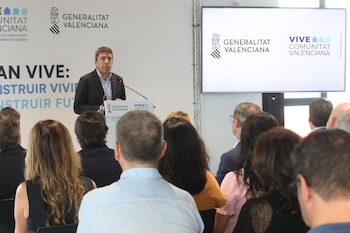
The ‘president’ of the Generalitat, Carlos Mazón, has emphasized the importance of fostering public-private collaboration to address the ongoing housing crisis. Speaking at a recent event focused on the second phase of land bidding for the Vive Plan, Mazón articulated his commitment to developing 10,000 public protection homes over the next two years. This ambitious initiative is backed by an investment of €7.326 billion and involves the construction of 6,000 homes on municipal land and 4,000 on private property , both for sale and rent.
During his address, Mazón stated, “We are in a new time in which the Generalitat does not view promoters and builders with suspicion, unlike the previous Consell.” He underscored the need for collaboration with local municipalities and the construction sector to tackle one of the most pressing issues for citizens: housing . He lamented the previous administration’s lack of action, stating that it delivered no social housing over eight years, contributing to an enormous imbalance between supply and demand.
Mazón emphasized that addressing the housing crisis is not merely an economic challenge or an issue of emancipation but a social necessity . “We are developing a comprehensive policy that guarantees legal certainty and acts as an incentive for all stakeholders involved,” he added, referencing the regulatory frameworks that have been established to support this initiative.
A Collaborative Framework for Development
A key aspect of the Vive Plan is its emphasis on institutional collaboration . Mazón highlighted the Framework Agreement with the Valencian Federation of Municipalities and Provinces , which aims to mobilize public land for housing projects. Remarkably, 317 municipalities across the Valencian Community have signed on to this initiative. This broad collaboration is intended to streamline the development process and bolster housing supply .
In addition to land mobilization, Mazón pointed to several other strategies designed to incentivize housing construction. These include the general reduction of the Patrimonial Transmissions Tax (ITP) and various administrative simplification measures. A particular focus has been placed on young people and vulnerable populations, with measures such as the Valencian Institute of Finance (IVF) providing guarantees for those entering the housing market for the first time.
Currently, there are approximately 3,000 public protection homes in various phases of development: tendering, awarding, and execution. Notably, around 2,000 of these homes are located in the province of Alicante. This represents significant progress and showcases the effectiveness of the policies Mazón’s administration has implemented to stimulate housing development.
The Fight Against Squatting and Improving Housing Conditions
Responding to inquiries about whether adequate labor resources were available to build the 10,000 homes proposed in the Vive Plan, Mazón expressed confidence that skilled labor is indeed present. He also stressed the need to enhance quality in construction practices. “Alicante is becoming a beacon for improving procedures and we are beginning to see tangible results,” he asserted, noting the reduction in taxes that was previously enacted to help young people access housing.
However, Mazón did not shy away from discussing the challenges posed by illegal squatting or “inquiokupación,” which he notes has become particularly prominent in Spain. He mentioned that a specific plan against squatting has been launched in the Valencian Community, aimed at providing direct legal support to property owners, particularly small property owners.
In a statement, the Generalitat indicated that investment in public property has seen a 30% increase compared to the 21 months of the previous administration. The upcoming 2025 budgets are expected to allocate a substantial portion for social expenditure, especially in the housing sector, which will see a 33% increase exceeding €304 million.
Alicante’s Local Initiatives
The mayor of Alicante, Luis Barcala, has also showcased local government efforts in promoting housing initiatives. The City Council is currently working on two new neighborhoods, enabling public lots, and initiating new developments to construct more than 6,000 homes —40% of which will be designated for public promotion. Under the Vive Plan framework, the local government has signed an agreement with the Consell to construct 220 protected housing units across five municipal plots.
Barcala emphasized the ambitious community-wide strategies in place, including the development of neighborhoods like Lomas del Garbinet and Nueva Albufereta. Each area is projected to host hundreds of new homes, along with essential commercial and community spaces. Moreover, rehabilitation projects targeting residential buildings in critical need of reform have also been prioritized, reinforcing the city’s commitment to improving overall living standards.
Through these multi-tiered efforts, both the Generalitat and the local government of Alicante have laid a robust foundation aimed at addressing the housing crisis comprehensively. By focusing on collaboration, modern regulations, and community-driven initiatives, they are working diligently towards ensuring that the Valencia community can enjoy not just homes, but vibrant neighborhoods conducive to a high quality of life.