
NICOLAS TUCAT / AFP
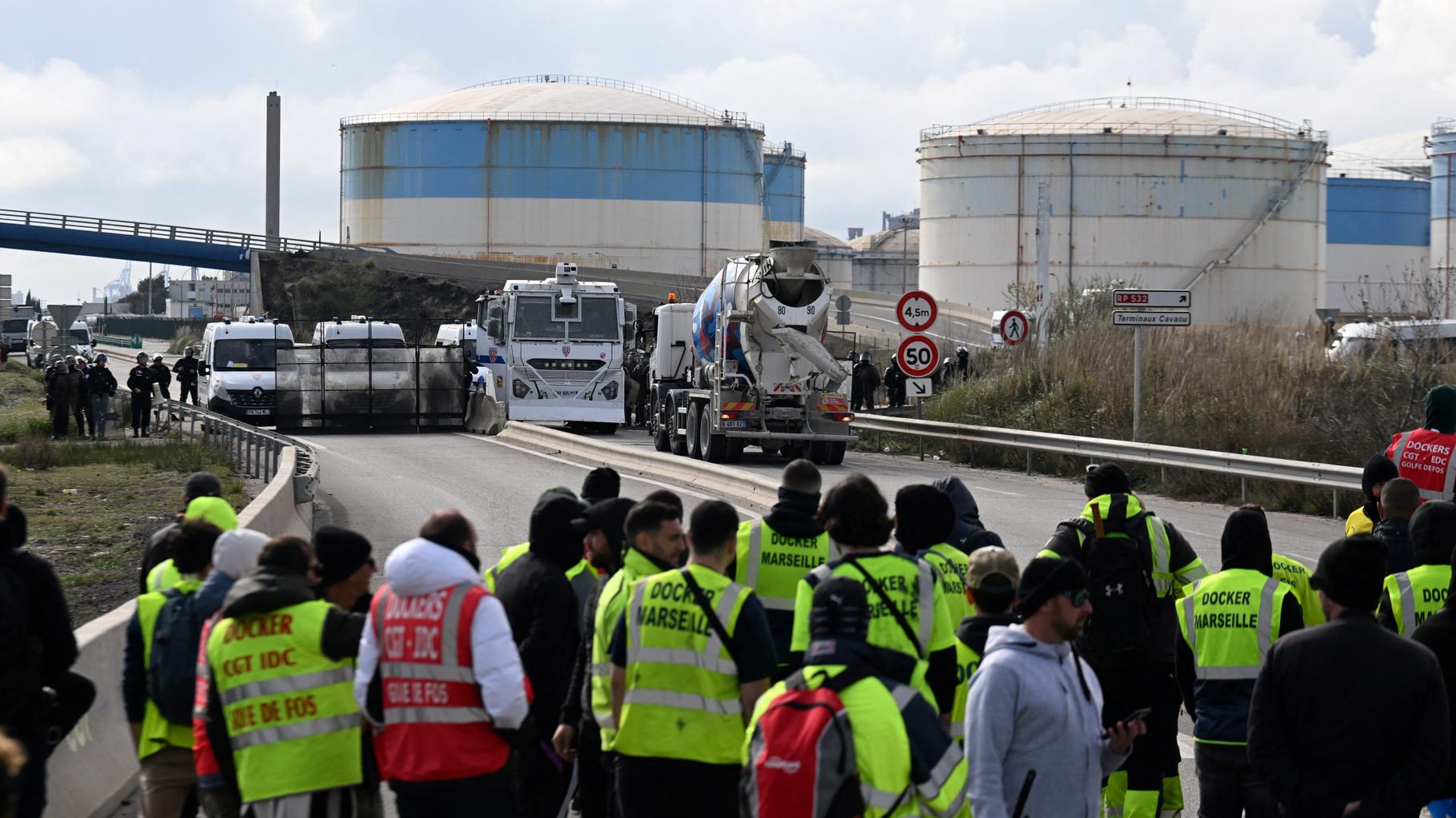
Dockers in Marseille-Fos refused to load military components destined for Israel. (illustrative photo)
In a significant act of protest , dockworkers at the Marseille-Fos port have taken a strong stance by refusing to load military components meant for Israel on Thursday, June 4. The decision was announced by the CGT, the workers’ union, expressing their intention to openly reject participation in what they termed the “ongoing genocide orchestrated by the Israeli government.”
“We were informed this morning that a ship, serving a regional line in the Mediterranean, was scheduled to load a container with parts for submachine guns manufactured by Eurolinks . We managed to identify and set it aside,” explained Christophe Claret , the Secretary-General of the dockworkers and port personnel of the Gulf of Fos. This act not only underscores their ethical considerations but highlights the growing conscientious objection among labor unions regarding military exports.
According to union sources, the controversial shipment consisted of 19 pallets of links produced by the Marseille-based company Eurolinks . When contacted, Eurolinks did not respond, and the Marseille-Fos port declined to comment on the matter.
Support from the Left
Claret asserted that the moment dockworkers refuse to load a particular merchandise, no one else can do so in their stead. However, other containers destined for the same ship were permitted to be loaded without opposition. The union’s official statement emphasized their commitment to peace and a strong stance against all forms of warfare.
“ Long live the dockers of Marseille-Fos! ” tweeted Manuel Bompard , a deputy from the left-wing party LFI (La France Insoumise) . He added that “ the struggle is organizing globally against the genocide in Gaza! ” Similarly, the leader of LFI, Jean-Luc Mélenchon , echoed these sentiments while calling for an immediate embargo on arms fueling genocide. The First Secretary of the Socialist Party, Olivier Faure , also expressed his congratulations on social media, stating: “ Humanism is not for sale. ”
Potential Civilian Usage of Military Gear
According to investigative reports by Disclose, two prior shipments of similar components had taken place between Fos-sur-Mer and Haifa on April 3 and May 22 . These metal links, essential for connecting ammunition for submachine guns, are believed to have a direct implication in civilian casualties, particularly in Gaza. The reports indicated that these items could possibly be designed to be deployed against civilians.
In response to these revelations, Sébastien Lecornu , France’s Minister of Armed Forces, had previously stated that these components exported by the Marseille company were meant to be “re-exported” by Israel, further complicating the international military export landscape. This brings into question the levels of accountability and the ethical considerations companies must take into account regarding the end-use of their manufactured goods.
This incident at the Marseille-Fos port casts a spotlight on the moral dilemmas surrounding military exports, where labor unions and workers increasingly find themselves at the heart of political discourse. As the international community continues to grapple with humanitarian crises, actions like this from dockworkers are emblematic of a larger movement advocating for accountability and ethical considerations in the arms trade.
Ultimately, the stand taken by the dockers of Marseille-Fos highlights a critical juncture in labor activism intersecting with human rights advocacy . Their refusal to engage in activities that contradict their ethical beliefs serves as an act of solidarity with the victims of military conflicts globally. This serves not only as a notable action but also as a profound reminder of the role of workers in shaping societal values and norms around issues of war and peace today.