
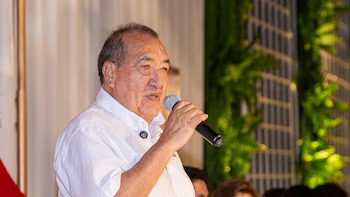
Mario Vizcarra’s Exclusion from Presidential Candidacy
The exclusion of Mario Vizcarra as a presidential candidate for Peru Primero has ignited significant controversy. Describing the decision as “unheard of,” the engineer and brother of former president Martín Vizcarra expressed outrage at the ruling made by the Special Electoral Jury (JEE) of Lima Centro 1. The JEE initially accepted his candidacy but later reversed its decision following objections that cited legal impediments.
Appeal and Reactions
In a tweet on X, Mario Vizcarra announced that he intends to appeal the JEE’s ruling, exclaiming confidence that the National Election Jury (JNE) will rectify what he refers to as “a headless decision that ignores the law.” He emphasized, “We fully trust that the JNE will bring order, correct this nonsense, and enforce the Constitution. They are not going to bend me!”
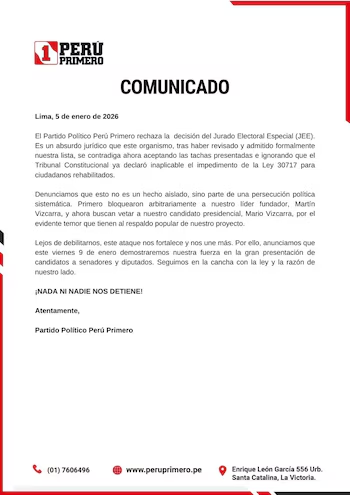
His political party also weighed in on the matter, labeling the decision a “legal absurdity.” They further argued that the Constitutional Court previously determined that Law 30717, which could be seen as an impediment, is inapplicable to rehabilitated citizens.
Peru Primero’s Response
“Far from weakening us, this attack strengthens us and unites us more,” the party remarked, announcing a showcase of their candidates for senators and deputies on January 9. They declared their commitment to continue fighting within the legal framework, asserting, “Nothing and no one stops us!”
Legal Implications of the Exclusion
Mario Vizcarra’s exclusion stemmed from a decision documented in Resolution No. 00065-2026-JEE-LIC1/JNE. This resolution arose after examining various objections citing his previous conviction for embezzlement as a permanent barrier to public office according to Law No. 30717. The law stipulates that individuals convicted of intentional crimes while in public office are disqualified from presidential candidacy, regardless of rehabilitation statuses.
Despite his arguments for rehabilitation that he submitted, the JEE reaffirmed its stance based on current electoral regulations prohibiting such individuals from running for office.
Constitutional Court’s Evaluation
The JEE further clarified that the Constitutional Court had not declared Law 30717 unconstitutional. As a result, the enforcement of this law remains mandatory. They emphasized that rulings from the Constitutional Court were specific and do not apply in a blanket manner, thereby sustaining the validity of the JEE’s decision.
In summary, Mario Vizcarra’s ongoing legal battle reflects broader issues of political justice and the interpretation of laws governing electoral eligibility in Peru. As Peru Primero stands firm in its commitment to appeal, the coming weeks will be critical for both the party and its candidate as they navigate this complex legal landscape.