
The Ambitious “Gran Diagonal” Project
Madrid is set to transform Line 11 of its Metro system, the least utilized line in the city, into a vital transportation artery known as the “Gran Diagonal.” This massive project aims to quadruple the line’s extension, connecting the southwest with the northeast of Madrid.
A Historical Overview
Line 11, inaugurated in 1998, marked a significant investment milestone for Madrid after two decades without new Metro lines. Originally, it comprised a mere 8.5 kilometers and seven stations, which paled in comparison to subsequent lines such as Metrosur and Light Metro lines, leaving it largely overlooked.
Current Usage and Expansion Plans
With an annual ridership of 10.8 million, Line 11 ranks as the least used Metro line, even trailing behind certain less functional branches. However, the Madrid authorities now envision expanding Line 11 significantly, positioning it to serve upwards of 75,000 daily passengers after its expansion.
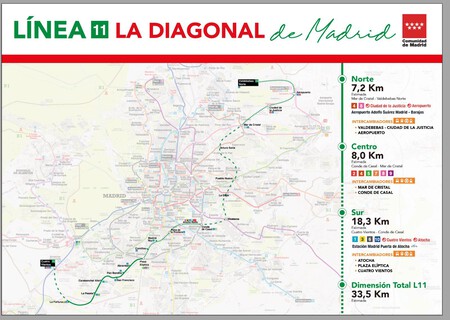
Map of the expansion of line 11
Key Developments in the Expansion
One of the project’s primary focuses is the connection between Plaza Elíptica station in Carabanchel and the Conde de Casal interchange. This section involves excavating over 6.5 kilometers and establishing two new stations: Comillas and Madrid Río.
With a commitment of 514 million euros for this segment, initial completion dates projected for 2026 have now been pushed to 2028. To expedite construction, a cutting-edge tunnel boring machine named Mayrit, capable of drilling 15 meters per day, is employed, significantly enhancing efficiency compared to traditional methods.
Future Expansion Plans
Subsequent phases of the Gran Diagonal will link La Fortuna station with Cuatro Vientos, comprising just over two kilometers and requiring an additional budget of 75 million euros. However, timelines for these extensions remain uncertain.
In the northern corridor of the project, the expansion towards Mar de Cristal will incorporate major stops such as Vinateros and Arturo Soria, backed by an investment of 600 million euros. Initial plans included extensions to Madrid’s airport, though specific execution dates remain elusive.
The Bigger Picture
Ultimately, once the Gran Diagonal project reaches its completion, Line 11 is expected to stretch approximately 33.5 kilometers and house 20 stations—an expansive increase from its original seven. This ambitious upgrade of the Metro line represents an investment exceeding 1.1 billion euros, aimed at significantly enhancing Madrid’s public transportation network.
The Gran Diagonal project could redefine how residents and visitors navigate Madrid, promoting not only accessibility but also sustainability in urban transport.