
During the annual fair of the Association of the United States Army, the Black Hawk helicopter reappeared unrecognizable. After decades of dedicated service, this iconic helicopter underwent a significant transformation, losing its traditional cabin and controls to gain a new bow that opens via two doors. This redesign has led to a revamped cargo hold, now known as the U-Hawk —a conversion executed by Sikorsky, a Lockheed Martin subsidiary. Within just ten months, a UH-60L transformed into an unmanned prototype boasting autonomous capabilities, and made its public debut at the AUSA event.
The U-Hawk was officially showcased on October 13 and is based on a former UH-60L from the U.S. Army. As reported by Lockheed Martin, the project evolved rapidly, transitioning from concept to demonstrator within this tight timeframe and is currently undergoing validation ahead of its inaugural flight slated for 2026. Up until now, Sikorsky has financed the development internally, leveraging its extensive experience in flight automation.
From Black Hawk to U-Hawk: The Old Helicopter That Is Reborn Without a Cabin
The most striking alteration lies in the front fuselage, where controls and instrumentation once resided; now, it features two clamshell-type gates that open to the side, complemented by a motorized ramp that enables loading and unloading even while the rotors are still spinning. This innovative design integrates a third-generation fly-by-wire system alongside MATRIX, Sikorsky’s autonomy technology that synchronizes sensors, cameras, and algorithms to manage flight operations autonomously. This transformation has yielded an increase of 25% in usable cargo space compared to a conventional UH-60L.
The extended front fuselage not only maximizes space but also enhances cargo capabilities. The U-Hawk is capable of carrying up to 3,175 kilograms internally and can lift an additional 4,080 kilograms using its external hook—similar to its Black Hawk predecessor but with more room for larger cargo. Its interior can now accommodate four standard JMIC containers , double the previous capacity, or a full pod containing six HIMARS rockets. The U-Hawk can also transport two Naval Strike Missiles for anti-ship operations and an unmanned ground vehicle that can enter and exit via its ramp.
Among the most innovative features is the internal launch system known as the quiver . This module, housed within the cargo bay, can hold between 24 to 50 drones or loitering munitions ready for mid-flight deployment. These payloads can be configured for various missions, including aerial surveillance, reconnaissance, or electronic warfare. Sikorsky asserts that this capability enables the U-Hawk to conduct autonomous operations prior to troop arrival, offering a proactive avenue for reconnaissance or terrain analysis.
Autonomy constitutes one of the U-Hawk’s standout features. As indicated by Lockheed Martin, the U-Hawk can travel up to 1,600 nautical miles —approximately 2,960 kilometers —without requiring external assistance, maintaining flight for up to 14 hours on a single refueling. The company suggests that it can be fitted with internal tanks to further extend this range, though specifics on whether these tanks are necessary for the maximum range haven’t been disclosed. Regardless, its operational capabilities are unprecedented for a helicopter of this category.
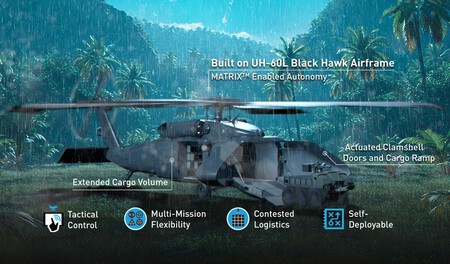
Sikorsky envisions the U-Hawk as an essential asset for modern air assaults. In a typical mission scenario, the helicopter would operate autonomously ahead of troop deployment, releasing multiple launched effects for surveillance and attack. Following this, it would land, deploy an unmanned ground vehicle, and then take off again without human intervention . This tactical sequence aims to reduce the risk to soldiers in hostile environments, while also being applicable for civilian operations such as disaster response.
To streamline operations, Sikorsky is aspiring to make the U-Hawk as user-friendly as an app. Mission objectives can be input via a tablet, after which the MATRIX software autonomously calculates the optimal route, manages takeoff, and oversees the entire flight. Operators can adjust the level of human intervention based on situational demands, ranging from closely monitored operations to minimal oversight. Additionally, the system can distinguish between military and civilian airspace, modifying its operational behavior accordingly.
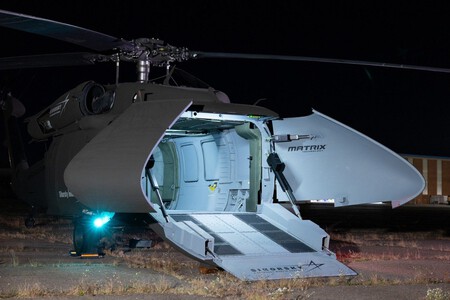
The U-Hawk also represents a commitment to cost-efficiency . Sikorsky is utilizing retired UH-60L fuselages from the U.S. Army, revamping them by replacing outdated flight systems and electronics with streamlined, cost-effective alternatives. This vertical integration allows Sikorsky to manufacture its management systems and actuators, reducing overall costs and simplifying maintenance. Remaining within the H-60 family grants the U-Hawk access to an established supply chain.
If everything proceeds as scheduled, the U-Hawk’s first flight should take place in 2026. This milestone will be crucial for assessing the feasibility of integrating full autonomy into the H-60 fleet, which the U.S. Army intends to maintain operational until at least 2070 . The concept of transforming a legacy helicopter into an unmanned platform hints at a future where manned and unmanned aircraft coexist harmoniously. The success of this prototype will be instrumental in shaping that vision.
Images | Lockheed Martin