
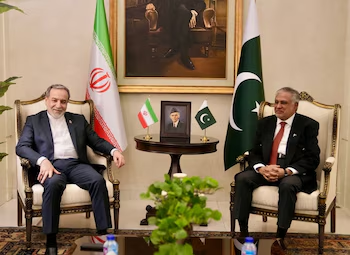
Iran’s Foreign Minister Delivers Responses to the US in Pakistan
State media in Iran recently reported that Foreign Minister Abbas Araqchi handed over a comprehensive list of “answers” from Tehran to U.S. proposals during high-level discussions in Pakistan. The precise content of this note remains undisclosed, though state broadcasters assert it fully addresses Tehran’s concerns.
U.S. Envoys Headed to Pakistan
On April 25, 2026, U.S. President Donald Trump announced that senior officials Steve Witkoff and Jared Kushner would be dispatched to Pakistan for potential ceasefire negotiations with Iran. Their arrival in Islamabad is anticipated, but the exact timing has yet to be confirmed. In a parallel move, the Trump administration imposed economic sanctions targeting a major Chinese oil refinery and around 40 shipping entities involved in transporting Iranian crude oil.
Key Meetings in Islamabad
Upon his arrival in Islamabad, Araqchi immediately met with Pakistan’s Foreign Minister Ishaq Dar and the Army Chief, General Asim Munir. These discussions reflect the importance of Pakistani mediation in the ongoing situation between Iran and the U.S. Concurrently, violence erupted in southern Lebanon, with the group Hezbollah dismissing a ceasefire extension between Israel and Lebanon as ineffective.
No Meeting with U.S. Representatives Planned
Iranian officials have made it clear they do not intend to meet with the U.S. delegation, composed of Trump’s son-in-law, Jared Kushner, and Middle East advisor Steve Witkoff, despite their impending visit to Islamabad. Araqchi’s journey includes plans for further regional consultations in Oman and Russia, emphasizing Iran’s intent to avoid direct negotiations with U.S. officials at this stage.
Iranian Military Stance
In a broader context of military posturing, the Iranian authorities have suggested that the U.S. seeks a way to withdraw from the ongoing conflict while maintaining a semblance of dignity. A spokesperson from Iran’s Ministry of Defense claimed, “Our military power is today a dominant force,” implying that the U.S. is entangled in a quagmire and looking for an exit strategy.
Threats Amidst Negotiations
Adding to the tense climate, Iranian military leaders issued threats of retaliatory strikes, warning that the country is prepared to unleash “the largest barrage of missiles in history” should any aggression be directed towards them, particularly concerning the ongoing ceasefire with the U.S. and Israel.
Arrests and Internal Security
Domestically, the Iranian Revolutionary Guard Corps (IRGC) reported the apprehension of nearly 240 individuals involved in alleged counter-revolutionary activities across the Kurdish regions, fortifying their internal security posture amid external negotiations.
Conclusion
As the negotiations unfold in Pakistan, the complexities of the Iran-U.S. relationship continue to deepen. The refusal of Iranian officials to engage directly with U.S. representatives highlights the ongoing tension and lack of trust, which will likely persist as both sides navigate this precarious situation. The international community remains watchful as potential consequences could reshape the geopolitical landscape in the region.