
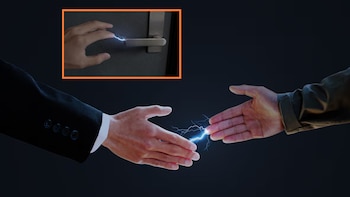
In everyday interactions, such as casual greetings or simple conversations, many individuals have experienced a slight electric shock when touching someone. This brief sensation or *spark* can elicit the familiar phrase, “ you passed me a current .”
While some may regard this as mere curiosity, science reveals it as a natural physical phenomenon linked to static electricity . Far from being m mystical or paranormal occurrence, it is a reaction that can be accurately predicted when certain conditions align.

Static electricity is generated when there is a discrepancy between protons (positive charge) and electrons (negative charge) in the atoms constituting objects and bodies. In their neutral state, these particles are balanced, but through friction between two surfaces—such as clothing while dressing or walking in certain footwear—electrons can migrate from one body to another, leading to a charge buildup.
In essence, the common expression “ you passed me a current ” arises from the energy imbalance between our bodies and another object during the electron transfer. This energy is discharged abruptly upon contact, resulting in the typical spark. It is an electric phenomenon of low intensity , but perceptible to the touch, especially at the extremities.

This phenomenon is not limited to objects. The human body, primarily composed of water and continuously interacting with electrical impulses for vital functions like neural communication or motility, can also function as a discharger and conductor of charge .
According to the University of Valencia, when in contact with insulating surfaces or synthetic materials like carpets or polyester clothing, an individual can store electric charge. At the moment this charge seeks to stabilize itself, touching another person with lower charge results in a brief but perceptible discharge.

Environmental conditions directly influence the frequency of this phenomenon. During winter or dry climates , static electricity manifests more intensely. The scientific portal UsefulBS explains that low humidity levels in the air prevent accumulated charges from dissipating easily.
Conversely, in a humid environment, the water particles present in the air act as conductors, facilitating the gradual discharge of electric charges before they can accumulate dangerously. This is why these “shocks” are more commonly felt in closed and dry spaces.

While this experience can be surprising, the discharge generated by static electricity is completely harmless in most cases. According to LiveScience, the voltage of these discharges can reach up to 20,000 volts , but the energy released (measured in millijoules) is minimal and rarely represents a real danger to health.
What one feels is a slight tingle , a muscle contraction instantly, or a sensation akin to pinpricks that fades away immediately. In controlled and everyday environments, this phenomenon poses no real risk. However, in specific industrial or medical contexts, these discharges could be dangerous if they interact with sensitive equipment or flammable substances.

To mitigate the frequency of these discharges, various specialists and research centers recommend preventive measures. One of the most effective ways is to maintain appropriate humidity levels in indoor spaces, using humidifiers if necessary.
Additionally, wearing cotton or wool clothing , as opposed to synthetic materials like nylon, can significantly reduce charge accumulation. It is also advised to avoid dragging your feet , choose shoes with leather soles, and touch metal objects—like a key or railing—before making contact with another person to discharge any accumulated energy.

Ultimately, the electric contact between individuals is grounded in well-studied physical laws. The moment someone “passes a current” is simply the outcome of interaction between electrically charged bodies. This invisible, silent, and ordinary phenomenon serves as a reminder that science is woven into the simplest gestures of daily life, illustrating that even the most unexpected experiences—like an electric touch among friends—has a rational explanation.