

What are the potential implications of the India-Pakistan conflict on global investment trends? How is Bitcoin perceived in relation to geopolitical instability? What role does the U.S. play in influencing Bitcoin prices according to the Russian lawmaker? How is Russia approaching the use of cryptocurrencies for cross-border trade and payments? What initiatives are Russian banks taking regarding stablecoins as alternatives to traditional fiat?
A senior Russian lawmaker says that intensifying India-Pakistan tensions will lead to a Bitcoin (BTC) price rise. Speaking to the Russian Parliamentary Gazette on May 7, Anatoly Aksakov, the Chairman of the State Duma’s Committee on the Financial Markets, also suggested that some states are now using BTC as a payment tool in cross-border arms deals.
India-Pakistan Conflict to ‘Spur Bitcoin Buying?’
The lawmaker explained that any escalation of military operations between India and Pakistan would see global investors start pouring their funds into assets such as gold, crypto, and other precious metals. Aksakov said:
“As a rule, such tense political situations work in favor of various investment instruments. These include Bitcoin and gold. Especially as Bitcoin is beginning to be used to pay for various weapons supply programs.”
He added that “in general, [Bitcoin] is a safe haven asset.” And that means that demand for BTC “grows during periods of geopolitical instability.” The lawmaker added that geopolitical uncertainty now unfailingly “stimulates interest in cryptocurrencies.”
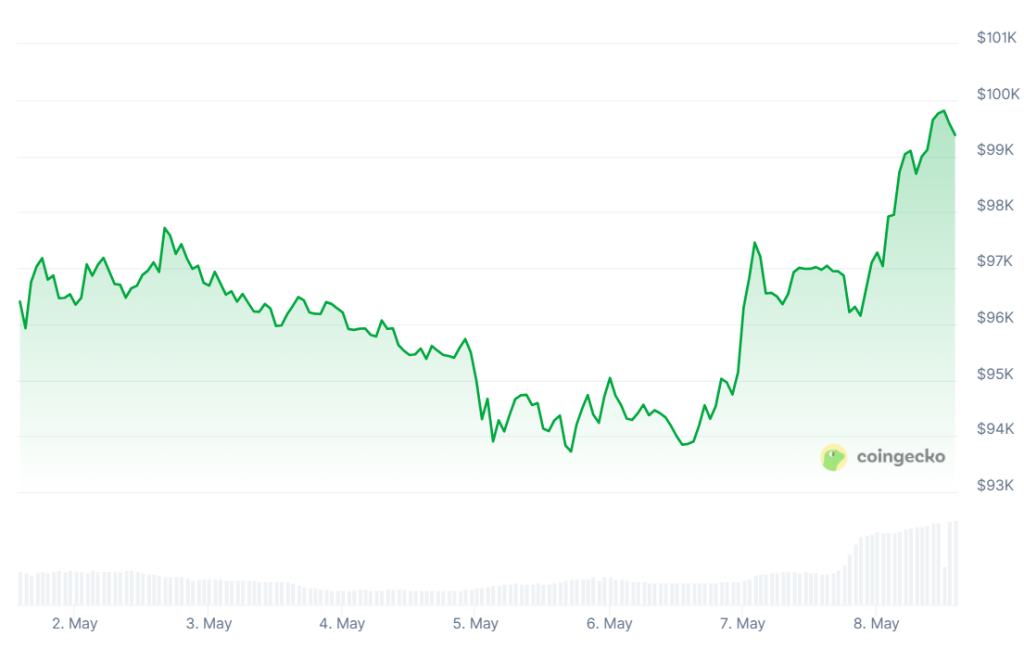
Bitcoin prices over the past week. (Source: CoinGecko)
However, he added, events in America still have “the greatest impact on Bitcoin” prices. This is because the US is home to the “largest number of Bitcoin owners in the world,” Aksakov explained. He concluded that an India-Pakistan conflict would “not affect the Russian ruble in any way,” noting that ruble prices depend almost entirely on Russian “internal economic conditions.”
Aksakov is the chief architect of all of Russia’s crypto legislation to date. He has previously claimed that Moscow is aware that domestic firms are using BTC and other tokens to conduct cross-border trade.
In September 2024, Russian reports claimed that Moscow had launched a focus group to explore crypto payments for so-called “dual-use goods.” Such goods can either be used for both civilian and military applications.
Moscow Eyes Stablecoin Solutions?
State-owned Russian banks are also looking to stablecoins in their search for an alternative to fiat settlements. In October last year, the state-run Promsvyazbank launched a cross-border settlement platform named A7. The bank says that the platform was designed to facilitate international payments. And TASS reported late last month that A7 operators are now “actively promoting [RUB-pegged] stablecoin adoption.”
The media outlet quoted Osman Kabaloev, the Deputy Director of Financial Policy at the Russian Ministry of Finance, as saying that blockchain-powered “settlement instruments based on the ruble” were “already in circulation and being used in one way or another.”
The post Top Russian Lawmaker: India-Pakistan Tensions Will Drive up Bitcoin Prices appeared first on Cryptonews.
Top Russian Lawmaker: India-Pakistan Tensions Will Drive Up Bitcoin Prices
In a recent discussion regarding global economic trends, one of Russia’s leading lawmakers, Anton Tkachev, has made a provocative assertion: the ongoing tensions between India and Pakistan could significantly impact Bitcoin prices. This assertion aligns with the growing recognition of cryptocurrency as a barometer for geopolitical stability, as investors increasingly turn to digital assets during times of crisis.
Understanding the Context
The relationship between India and Pakistan has long been characterized by friction, rooted in a complex history of territorial disputes, cultural differences, and ongoing military skirmishes, particularly over the Kashmir region. The potential for conflict between these two nuclear-armed nations not only poses significant geopolitical risks but also creates unpredictable economic scenarios that can influence global markets, including cryptocurrencies.
As both nations engage in military posturing and diplomatic negotiations, the volatility of the situation can lead investors to seek alternative assets. Historically, during periods of heightened geopolitical tensions, there has been a noticeable shift in investment patterns. Traditional markets can react negatively to uncertainty, while cryptocurrencies like Bitcoin—often viewed as a safe haven—can witness price surges.
The Role of Cryptocurrencies in Geopolitics
Cryptocurrencies have evolved beyond niche investments, becoming a mainstream financial asset class. Bitcoin, as the first and most well-known cryptocurrency, serves as a digital gold, offering a hedge against inflation and economic instability. In situations like the India-Pakistan tensions, cryptocurrencies enable individuals and businesses to transact outside traditional banking systems, which can be particularly appealing when access to those systems is restricted due to political reasons.
Moreover, as nations grapple with harsh economic sanctions or unstable currencies, cryptocurrencies often provide a means for financial transactions that are less susceptible to government control. This has led to increased adoption in regions experiencing political unrest, thereby linking geopolitical events more closely with Bitcoin price fluctuations.
Market Reactions to Geopolitical Events
The cryptocurrency market is notoriously volatile, with prices influenced by a myriad of factors including market sentiment, news events, and regulatory changes. When geopolitical tensions rise, there can be a palpable shift in investor behavior. For example, during the Russian invasion of Ukraine, Bitcoin saw substantial price hikes as investors fled traditional markets. Similarly, should tensions escalate between India and Pakistan, a rush toward Bitcoin could result in a dramatic increase in its value.
The theory put forth by Tkachev suggests that as the situation develops, investors may increasingly perceive Bitcoin as a reliable asset. This anticipated influx of capital could potentially lead to a higher demand for Bitcoin, impacting its price positively.
The Broader Implications for Crypto Adoption
Tkachev’s comments are not merely speculative; they highlight a broader trend of cryptocurrency adoption amid geopolitical turmoil. As more individuals come to recognize Bitcoin’s utility in uncertain environments, its role as a financial instrument will likely solidify. This trend is observable in countries such as Venezuela and Iran, where citizens have turned to cryptocurrencies to preserve their wealth and circumvent heavy state control over finances.
In the context of India and Pakistan, a sustained increase in Bitcoin prices could also benefit local economies. Residents in both nations could find themselves more engaged in international digital markets, potentially enhancing cross-border trade and remittances. This aspect adds another layer to the discussion, indicating that local responses to geopolitical tensions can also influence global cryptocurrency dynamics.
Criticism and Skepticism
While Tkachev’s assertion may hold merit from a speculative standpoint, it is crucial to acknowledge that the cryptocurrency market is influenced by various factors beyond geopolitical tensions. Critics may argue that relying on political instability as a determinative factor for Bitcoin prices oversimplifies the complexities of the market.
Furthermore, the assertion may raise eyebrows among skeptics who believe that Bitcoin’s value should be driven by intrinsic demand and utility rather than the weight of geopolitical drama. Regulatory factors, market manipulation, and overall confidence in cryptocurrencies are just a few of the elements that can also significantly weigh in on Bitcoin’s price movements.
Conclusion
The intersection of geopolitical tensions and cryptocurrency values presents a fascinating lens through which to view modern finance. Russian lawmaker Anton Tkachev’s claim that rising India-Pakistan tensions may drive up Bitcoin prices underscores the growing importance of cryptocurrencies in a globally interconnected financial landscape.
As situations evolve and uncertainties mount, Bitcoin and other cryptocurrencies may continue to serve as barometers for both economic stability and investor sentiment. For investors, being aware of geopolitical dynamics could be as important as understanding market trends or regulatory environments, making the world of cryptocurrencies even more intricate.
Ultimately, the situation serves as a reminder of the inextricable link between our political realities and financial instruments, and the potential for Bitcoin to emerge not just as an asset but as a transformative financial lifeline in times of need.
A top Russian lawmaker has suggested that increasing tensions between India and Pakistan could lead to higher Bitcoin prices. He posits that geopolitical instability often drives investors towards cryptocurrencies as safe havens. This reflects a broader trend where investors seek alternative assets during times of uncertainty. The statement highlights the interconnectedness of global events and financial markets, particularly in how geopolitical factors can influence cryptocurrency valuation.