
Kaja Kallas Urges Diplomatic Solutions for the Strait of Hormuz
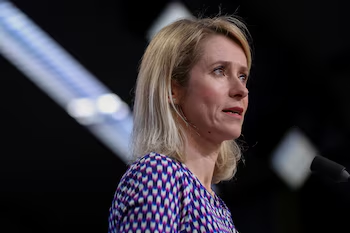
EU High Representative for Foreign Affairs and Security Policy, Kaja Kallas, speaks during a closing press conference at a European Union Energy and Foreign Affairs ministers meeting in Brussels, Belgium, March 16, 2026. REUTERS/Omar Havana
The Current Situation in the Strait of Hormuz
In recent developments, Kaja Kallas, the head of foreign policy for the European Union, has emphasized the urgent necessity of finding a diplomatic resolution that allows ships to safely navigate through the strategically vital Strait of Hormuz. The call for diplomacy comes after Iran’s restrictive measures on maritime traffic, which were implemented in response to escalating military tensions in the region.
Since the onset of conflict involving the United States and Israel, the Strait has seen limited access for vessels, prompting concerns over global economic stability. Kallas stated that it is imperative to resume the flow of shipments through this corridor to avert significant crises related to food, fertilizers, and energy supplies.
Economic Implications of the Strait’s Closure
The ramifications of restricted access through the Strait of Hormuz are staggering. Approximately 20% of the world’s oil and gas traverses this critical chokepoint, primarily impacting Asian markets. Kallas warned that any interruption in the supply of fertilizers could lead to dire consequences, including famine in the coming year. The urgency of the situation cannot be overstated, with global food security hanging in the balance.
“We are facing a war of great dimensions and many consequences. That is why we seek to work with partners to collectively convince the warring parties to stop,” Kallas articulated during a recent press conference.
Diplomatic Priorities and Challenges
As part of ongoing diplomatic efforts, Kallas has engaged in discussions with UN Secretary-General António Guterres regarding the maintenance of free navigation in the Strait. The EU identifies it as an “urgent priority” to resume shipments of essential goods. Currently, the EU’s naval operations, such as ASPIDES, play a crucial role in safeguarding maritime transport in the region.
However, Kallas cautioned that the complexities of international maritime logistics pose significant challenges. Natural fears of heightened risks lead insurers to increase premiums, while ship crews are reluctant to embark on voyages perceived as dangerous. “You have to be careful,” Kallas noted, highlighting the necessity for “concrete and tangible results” that assure safety and peace in travel.
The European Union’s Stance
Despite the pressing nature of the situation, EU leaders, including German Defense Minister Boris Pistorius, have asserted that any military participation from Europe will be avoided. They maintain that the EU is not involved in the conflict, emphasizing a commitment to diplomacy rather than military engagement.
As the situation evolves, Kaja Kallas and EU leaders continue to prioritize de-escalation and secure maritime passage, striving to restore stability to a region critical for global trade and economic well-being. The forthcoming days and weeks will be crucial in determining the viability of diplomatic strategies to keep the Strait of Hormuz open and operational.