
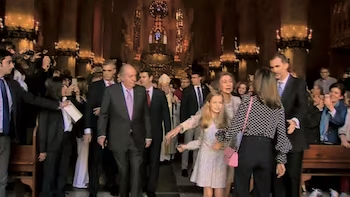
Juan Carlos I Reflects on the Palma Incident
The long-awaited autobiographical book of Juan Carlos I, titled Reconciliation, has recently hit bookstores in Spain. Co-written with Laurence Debray, the book has stirred considerable buzz, particularly around its revelations concerning family tensions. Among the most notable passages is Juan Carlos’s account of a controversial moment from Easter mass in Palma in 2018, centering on a confrontation between Queens Letizia and Sofía.
A Notorious Family Altercation
Juan Carlos revisits the infamous incident where a seemingly benign family photograph spiraled into public drama, reigniting discourse surrounding the royal family’s internal struggles. As detailed in his book, Queen Sofía attempted to pose with her granddaughters while Letizia positioned herself to block the shot, causing evident discomfort. This moment was witnessed by King Felipe VI and Juan Carlos himself, leading to an awkward “we have to talk” issued by the emeritus monarch to his son Felipe.
Letizia’s Reaction and Juan Carlos’s Critique
Juan Carlos candidly describes the fallout from this encounter, asserting: “It turned out to be a disaster.” He expresses frustration that Letizia’s actions, perceived as anger towards Sofía, undermined the intended message of family unity that was supposed to be on display. He critiques the crafting of public appearances, asserting, “The montages of the communicators do not achieve miracles. I believe more in spontaneity and truthfulness.”
Insights from a “Lone Wolf”
Beyond familial conflicts, Juan Carlos’s book probes into his emotional terrain, emphasizing a sorrow for not having shared meaningful experiences with his granddaughters, Leonor and Sofía. He reflects on the physical proximity he had to them yet lamented the absence of strong familial ties. His portrayal of Letizia and Felipe as nurturing parents stands in contrast to his sense of isolation, where he terms himself as a “lone wolf.”
Economic Challenges and Modern Family Dynamics
Juan Carlos also addresses past misconceptions, notably regarding the sale of his yacht, Fortune, which he attributes to impractical maintenance costs. This touches upon the pressing need to adapt the royal family image in contemporary Spain, where traditional expectations clash with modern realities.
Conclusion
Juan Carlos’s autobiography sheds light on the complex dynamics of the Spanish royal family, particularly the tensions that can arise under public scrutiny. His candid reflections not only provide a personal glimpse into royal life but also invoke broader conversations about family expectations, public image, and the desire for genuine connections amidst royal protocols.