
The first thing is the message.
An electrical current that crosses the brain.
And everything is unleashed.
The brain sends the signal: more wood for the locomotive.
The nervous system executes the order. More fibers and more fast fibers are put into motion. The muscles demand more energy. The heart rate goes up. The heart pumps more blood. With blood comes oxygen. And the quadriceps, the hamstrings, the calves become the coupling rod of the locomotive.
Boom. Boom. Boom. Up and down.
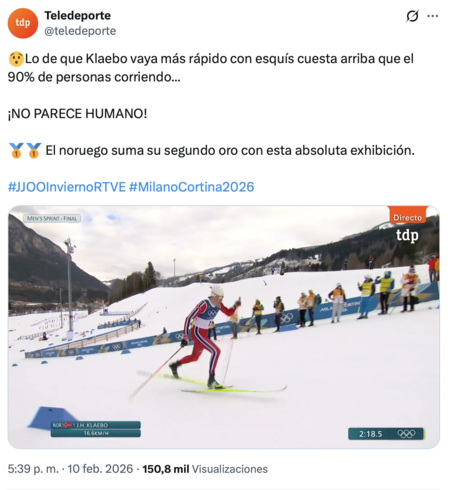
Johannes Klæbo only needed to steam his head.
Its engine already seemed to be running at full capacity when the storm hit. How wrong we were. It remained to be seen how he crushed the ground with his skis with the frequency of someone fleeing from the enemy but the rage of someone who crushes him. With the determination of someone who knows they are making history.
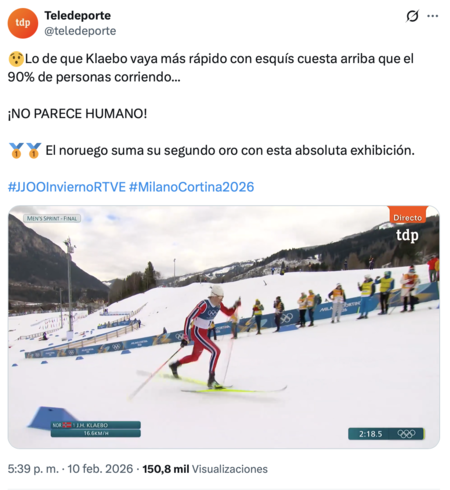
Click on the image to go to the original tweet (and see the devastating attack)
An Overwhelming Number
Three minutes and 40 seconds to cover a thousand meters.
Nothing too special if we talk about putting on sneakers and hitting the asphalt. Very different when you put on skis, face a slope, and reach peaks of 18 km/h to destroy your rivals.
This is how Johannes Klæbo broke the sprint distance cross-country ski race.
3’39″74
Less than 220 seconds to cover a distance of 1,585 meters on skis. Where, of course, you go down, but where you also have to go up. Klæbo let himself go in the final meters, enjoying his overwhelming superiority as he did before, much like Usain Bolt in Beijing in 2008. How will you enjoy? Check out Remco Evenepoel with the Eiffel Tower behind him in 2024.

Or as Tadej Pogacar echoes repeatedly, the athlete he is most compared to for his dominance.
Johannes Klæbo was born in Trondheim (Norway) in 1996. He will turn 30 in October. By then, he will likely showcase 15 gold medals accumulated in World Cups in his living room. On the opposite wall, his nine Olympic medals will stand out, seven of them gold. Who knows? Perhaps four more may accompany him, just like they did at the 2025 World Cup in Trondheim, his hometown.
With gold in the speed test and the 10+10 kilometer skiathlon, this Norwegian could become the Winter Olympian with the most gold medals in history.
The current record is held by two other Norwegians. Marit Bjørgen, a distance runner, holds the most Olympic medals in winter games with eight golds, four silvers, and three bronzes. She is followed closely by Ole Einar Bjørndalen, a biathlete with the same tally of eight golds, four silvers, and two bronzes. If Klæbo wins six golds at the Milano Cortina 2026 Olympic Games, he will have 13 medals (but with 11 golds), elevating him to an unprecedented level. So far, he has won seven.
Klæbo is a force of nature, dominating every distance record and race type within his sport. Much like Pogacar, Armand Duplantis, or Kilian Jornet, he belongs to a select group of athletes destined for greatness. Their triumphs crush any insurrection, transforming competition into unmissable spectacles.
Furthermore, Johannes Klæbo is part of a generation of Norwegian athletes breaking all norms.
Jakob Ingebrigtsen reflects a father who obsessively promoted double threshold training among his children. Karsten Warholm was the first man to shatter the 46-second barrier in the 400-meter hurdles. Kristian Blummenfelt is the triathlon world and Olympic champion. Johannes Thingnes Bø, a retired biathlete, boasts five Olympic golds, two silvers, and two bronzes. Lastly, Magnus Carlsen is another genius among them, where only “The World” might place limits.
Photo | Olympics
In Xataka | The Winter Olympics are facing the most unexpected technological doping: penis punctures