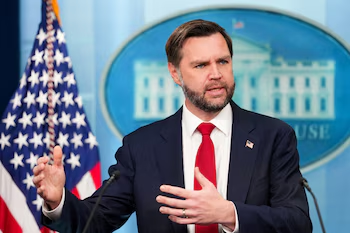
JD Vance Urges Smart Decisions from Cuba Amid Negotiations with Washington
The Vice President of the United States, J.D. Vance, recently urged Cuban authorities to make “intelligent decisions” during ongoing negotiations between Washington and Havana regarding the future of Cuba. This statement came amid discussions about the possibility of Cuba becoming the next country to reach an agreement, following a similar diplomatic breakthrough with Iran.
Cuba’s Economic Challenges
During a press conference, Vance characterized Cuba as “a system that has not worked,” noting that its economic situation may be “probably worse than the Iranian economy.” He emphasized the significance of Cuba’s geographical proximity to the United States, highlighting that each crisis on the island often results in a surge of “desperate” migrants arriving on U.S. shores. Vance stated, “We want the Cuban people to be happy and successful,” expressing hopes for positive changes from the Cuban government.
Negotiation Dynamics
Vance articulated that the U.S. is keen to see how the Cuban government proceeds, suggesting that any positive actions from Cuba would yield a better relationship between both nations. He clarified that the U.S. response would depend on Cuba’s decisions, emphasizing, “If they make smart decisions, we will have a much better relationship with that island.”
Complicating the backdrop of these negotiations is the context of U.S. policies that have included stringent measures, such as an oil blockade imposed by the previous administration following events in Venezuela. The blockade aimed to pressure Cuba towards political and economic reforms.
Recent Developments in Cuban Governance
Vance’s comments came shortly after a set of significant economic reforms was approved by the National Assembly of Popular Power of Cuba. This reform package has been described as the most extensive in decades, focusing on greater autonomy for municipalities and state-owned enterprises, agricultural recovery, and the opening of foreign trade. These reforms mark a notable shift in the government’s approach, with Miguel Diaz-Canel acknowledging internal issues impacting production, rather than attributing all challenges to external factors like the U.S. embargo.
This reform agenda indicates a readiness within the Cuban leadership to explore market-based solutions inspired by models from China and Vietnam, while still maintaining the overarching presence of the state. Notably, the reforms also allow for Cubans abroad to invest in the country equally alongside state enterprises and foreign capital—a significant policy shift heralded as a potential catalyst for economic revival.
Conclusion
The evolving U.S.-Cuba relationship remains intricate and laden with history. Vance’s call for “intelligent decisions” highlights a potential reopening of diplomatic channels that could facilitate reforms in Cuba, ultimately benefiting its citizens. As both nations navigate this complex landscape, the choices made in the coming months could significantly impact the social and economic fabric of Cuba.