
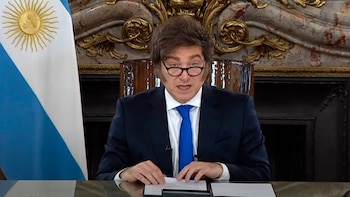
In a kind of theoretical complement to the speech he read on Friday night via national chain, President Javier Milei made a long post on the social network X, explaining why, in his opinion, the recent movements of the dollar will not have inflationary effects. He highlighted the importance of monetary policy as the ultimate cause of inflation.
Understanding Currency Movements and Inflation
In recent weeks, currency fluctuations have been a topic of heated debate in Argentina . Economists and analysts warn about potential inflation following the recent volatility of the dollar, but President Milei offers a counter-narrative. He argues that the economic measures taken by his administration will mitigate potential inflationary consequences.
Milei’s assertions are based on economic theory : he believes that the fluctuations in the dollar’s value are not inherently tied to inflation. Instead, he posits that monetary policy and the management of the money supply are primary drivers of inflationary pressures. The dollar’s value, in his view, is a reflection of broader economic factors, which include market confidence, political stability, and global economic trends.
The Role of Monetary Policy
Monetary policy entails the actions of a central bank or currency board to control the money supply, often targeting inflation or interest rates. The Central Bank of Argentina , under President Milei’s guidance, is working on strategies to stabilize the economy without resorting to imprudent measures like currency controls, which are often criticized for causing more harm than good.
Milei mentions that many analysts have misjudged the situation, often remaining stuck in a loop of outdated analyses and negative forecasts. He emphasizes the importance of shifting perspectives to understand the complexities of modern economics. According to him, several analysts’ persistent errors reveal a deeper misunderstanding of the actual dynamics at play within the Argentine economy .
Addressing Economic Misconceptions
In his post on X, President Milei pointed out that despite the continuous changes in currency value, many economists continue to advocate for the same policies that have historically failed to achieve desired outcomes. He highlights that economic indicators should guide decisions rather than mere speculations that often lead to doom-and-gloom narratives.
The exchange rate is an essential component of the economy that interacts with both internal and external markets. While fluctuations can intimidate merchants and consumers, Milei’s visible confidence aims to assuage fears and stabilize public opinion as his administration begins to unveil its strategic plans for economic recovery.
Future Projections and Outlook
Milei insists that the focus should not solely be on the immediate impact of dollar fluctuations, but rather on developing a sustainable plan that promotes economic growth and stability. His administration is set to introduce a series of reforms that target inflation control, investment stimulation, and international trade enhancement.
While opinions remain divided on these matters, there is a consensus that the Argentine economy requires careful navigation through turbulent waters. The interplay of politics and economics creates a complex landscape, and President Milei’s approach attempts to fuse theoretical economic concepts with practical realities.
As his administration moves forward, stakeholders are keenly watching the developments in monetary policy and its implications not only for the Argentine economy but also for its position in the global market.
The upcoming weeks and months will be crucial in determining whether Milei’s theories hold true in practice, or if they will succumb to the mounting external and internal pressures that have historically plagued the Argentine economy. The world waits as Argentina navigates its economic future under the leadership of President Milei.
General News – 2